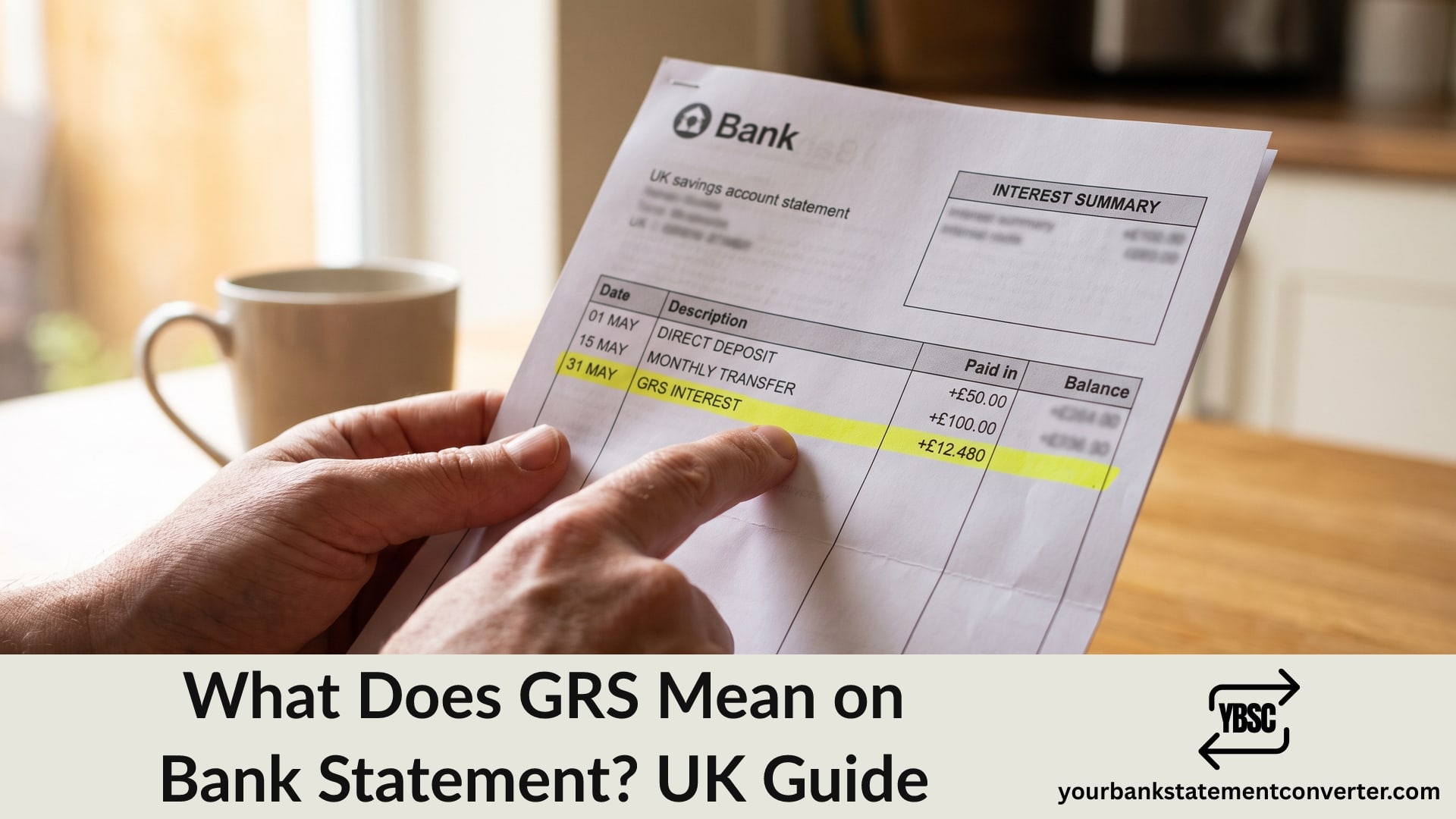
Three letters turn up beside a small credit, and nothing on the page explains them. Asking what does GRS mean on a bank statement usually means you have spotted it next to interest, a savings account, or a payment you cannot place.
This guide covers the likely meanings, explains why your bank does not publish GRS as a standard code, and shows you how to confirm which one applies to your account.
Key Takeaways
- GRS most often abbreviates “gross”, meaning interest paid before any tax deduction.
- It appears on savings and interest-bearing accounts more than current accounts.
- GRS is not on the published code lists that Barclays and other UK banks maintain.
- Where the entry is a payment out rather than in, GRS is likely a company’s initials.
- Check whether the amount is a credit or a debit first, because that decides which meaning applies.
What Does GRS Mean on a Bank Statement?
Start by checking the direction of the money, since that narrows it immediately.
Beside money paid in, GRS almost certainly means gross. Banks use gross to describe interest paid without tax taken off. Since the Personal Savings Allowance arrived, most UK savers receive interest gross and settle any tax owed separately. Such credits often carry a CR marker too.
Beside money paid out, GRS is not an interest term at all. In that case the letters are identifying a business, in the same way that any set of initials on a Direct Debit does.
That single check, credit or debit, resolves most cases before you go any further.
Why Gross Interest Appears on Your Statement
Gross means the full amount of interest before deductions. Net means what is left after tax.
Before 2016, banks deducted basic rate tax from savings interest automatically and showed the net figure. The Personal Savings Allowance changed that, so most accounts now pay gross and leave the tax to you.
This matters for two reasons:
- The interest figure on your statement is the taxable amount, which is what HMRC expects to see
- A gross figure looks larger than the old net one, which occasionally surprises people comparing old and new statements
If you need the yearly total, your bank issues an annual interest summary. That document, rather than an individual GRS line, is what you want at tax time.
Why Your Bank Does Not List GRS as a Code
UK banks publish abbreviations for transaction types, meaning how money moved. Barclays lists codes such as BGC, STO, DDR and CHAPS, and our guide to statement abbreviations covers the common set.
GRS does not appear on those lists. It is a descriptive label attached to interest, or it is a party name, so it falls outside the transaction type vocabulary banks bother to document.
Because no standard forces agreement, treat any confident single definition with caution and check your own bank’s help pages first.
How to Identify a GRS Entry You Cannot Place
Take these in order.
Check whether it is a credit or a debit. Money in points to interest. Money out points to a company.
Look at the account type. GRS on a savings account, ISA or bond is almost certainly interest. On a current account used only for bills, a company is more likely.
Check the timing. Interest usually lands on a fixed day each month, quarter or year, and often on the same date as the account anniversary.
Read the untruncated description. Banking apps shorten text. The PDF statement or online banking usually shows more, sometimes including the word “interest” in full.
Then ask your bank. Give them the date and amount. They can see the underlying record and will confirm in one call what a search cannot.
When GRS Is a Payment Rather Than Interest
If the entry takes money out, work it like any unfamiliar merchant. Compare the amount against your regular commitments, since a steady monthly figure suggests a subscription or membership.
Check who else holds a card on the account too. Joint holders generate entries that look unfamiliar to everyone except the person who made them.
Do not cancel a Direct Debit before you identify what it pays for. Stopping an active agreement without settling the balance can leave you in arrears.
Adding Up a Year of Interest Without Reading Twelve PDFs
Finding one GRS line is easy. Totalling every interest payment across a tax year, across two or three accounts, is where it gets tedious.
Our bank statement converter turns PDF statements into clean, searchable spreadsheets. Filter the description column for GRS or interest, then sum the amounts. What takes an evening of scrolling becomes one column total.
Conclusion
To sum up, asking what does GRS mean on a bank statement has two answers, and the direction of the money tells you which. Beside a credit, GRS abbreviates gross, meaning interest paid before tax, and it appears most often on savings accounts.
Beside a debit, treat GRS as a company’s initials and identify it the way you would any unfamiliar merchant. Run that one test first, then call your bank if the entry still does not resolve.
FAQ
1.What does GRS mean on a bank statement?
GRS usually stands for gross, meaning interest credited before any tax is deducted. It appears mainly on savings and interest-bearing accounts. Where the entry takes money out, it is more likely a company’s initials.
2.Is GRS an official bank code?
No. Barclays and other UK banks do not include GRS in their published abbreviation lists, which cover transaction types such as BGC, STO and DDR rather than descriptive labels.
3.What is the difference between gross and net interest?
Gross is the full interest before tax. Net is what remains after tax is deducted. Since the Personal Savings Allowance was introduced, most UK accounts pay interest gross.
4.Do I pay tax on gross interest?
You may. The interest is paid without deduction, so any tax due is settled through your Personal Savings Allowance and, if you exceed it, your tax return. Your bank issues an annual summary for this.
5.Why is GRS taking money out of my account?
Then it is not an interest label. Treat the letters as an abbreviation of a company name and identify it by amount, timing and the full description, or ask your bank to trace it.
6.Where do I find my total interest for the tax year?
Your bank issues an annual interest certificate or summary. That is more reliable for tax purposes than adding individual statement lines together.