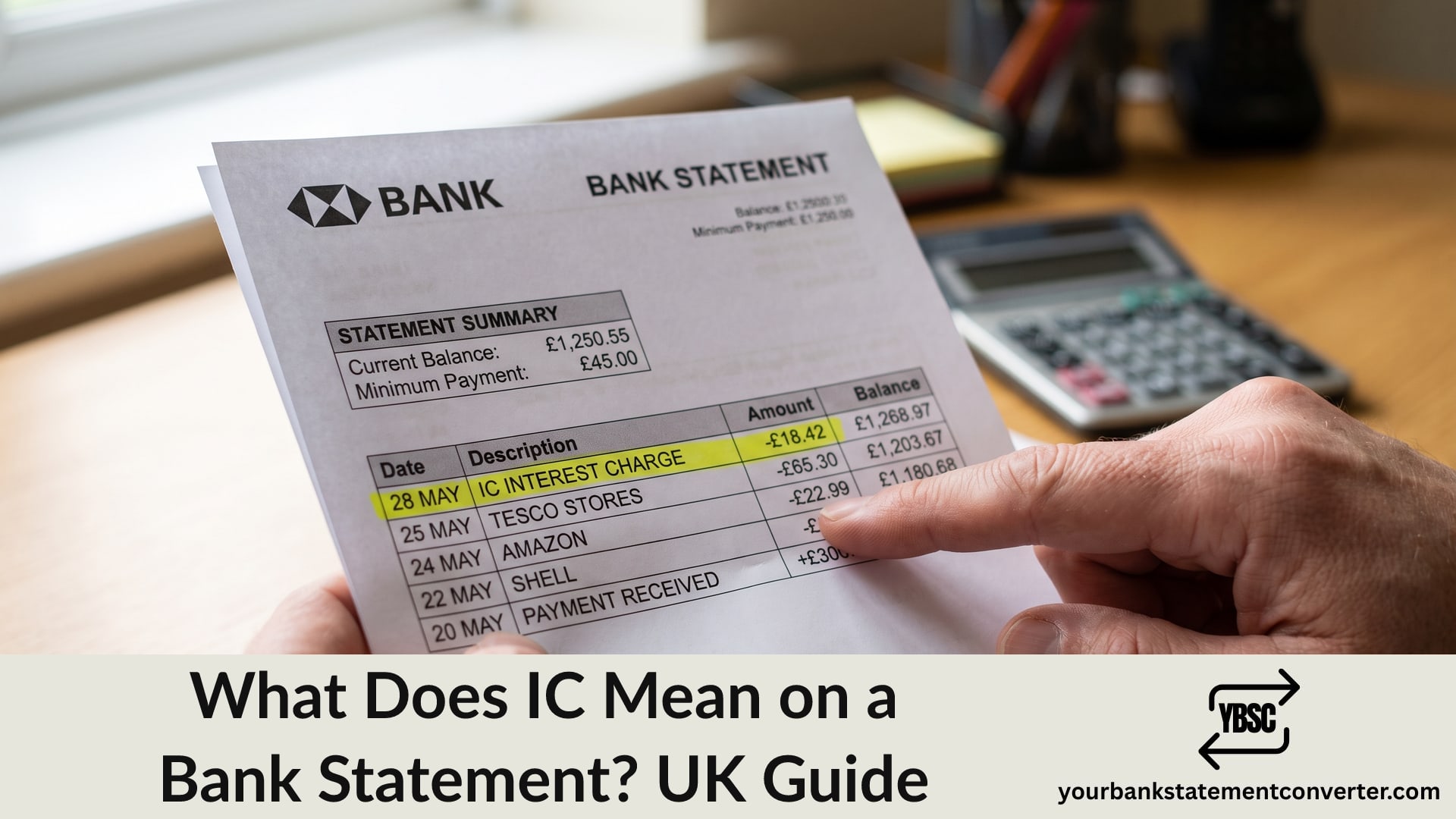
Two letters, sitting next to an amount you did not expect. So what does IC mean on a bank statement? Frustratingly, no UK bank publishes a single official definition.
That is genuinely useful to know, because it stops you hunting for a code that does not exist. This guide covers the meanings IC actually carries and shows you how to pin down which one applies to your account.
Key Takeaways
- IC has no standard UK banking definition. It appears on no major bank’s published code list.
- Beside a charge, IC most often shortens interest charge.
- Written as
IC*something, it is a payment processor prefix and the merchant follows the asterisk. - It can equally be a company’s initials on a Direct Debit or card payment.
- The direction of the money and the account type narrow it down in seconds.
What Does IC Mean on a Bank Statement?
Three explanations cover almost every case, and one quick test separates them.
Interest charge. On a credit card, overdraft or loan, IC beside a debit is usually the interest applied for the period. Some banks write it in full, others abbreviate. Related markers like DR show when an account is overdrawn.
A payment processor prefix. Entries shaped like IC* come from a payment gateway. The letters identify the gateway, and the text after the asterisk names the business you actually paid.
A company’s initials. Insurance companies, clubs, colleges and care providers all abbreviate themselves on Direct Debits, and IC is a common pairing.
Look at the account first. Credit cards lean towards interest, while current accounts lean towards a company.
Why No Bank Publishes IC as a Code
UK banks document abbreviations for transaction types, meaning how the money moved. Barclays publishes codes such as BGC, STO, DDR and CHAPS, and our guide to statement abbreviations collects the common set.
IC does not sit in that vocabulary. It is either a description of a charge or the name of a party, and banks do not publish lists of either. That is why forum threads asking this exact question rarely reach a definitive answer.
Because no standard forces agreement between banks, always check your own bank’s help pages before trusting a general list.
How to Identify an IC Entry on Your Statement
Work through these in order. Most people land on the answer within two steps.
Check the account type. A credit card, loan or overdrawn current account makes an interest charge far more likely. A savings account makes it far less likely.
Check whether it is a debit or a credit. Interest charges take money out. Money coming in points elsewhere entirely.
Look for a pattern. Interest charges appear on a regular cycle, usually monthly and often on the statement date itself. A one-off odd amount suggests a purchase.
Read the untruncated description. Banking apps shorten text aggressively. Open the same transaction in online banking or on the PDF statement, where you may find the full wording or text after an asterisk.
Then call your bank. Give them the date, amount and exact description. They can see the underlying record, which no amount of searching will give you.
When IC Is an Interest Charge
If the entry turns out to be interest, it is worth understanding what triggered it rather than just accepting it.
- Credit cards apply interest when you carry a balance past the payment date rather than clearing it in full
- Overdrafts accrue it daily on whatever you are overdrawn by
- Loans build it into the repayment schedule as the cost of borrowing
Interest charges are also worth tracking over time. A charge that grows month on month usually means the underlying balance is growing, and that is the thing to address rather than the charge itself.
When IC Is a Company or a Merchant
If interest does not fit, treat IC the way you would any unfamiliar merchant name.
Compare the amount against your regular commitments first. A steady monthly figure suggests a subscription, membership or insurance policy. An irregular amount suggests a card purchase.
Check who else holds a card on the account too, since joint holders and second cardholders generate entries nobody else recognises.
Do not cancel a Direct Debit before identifying what it pays for. Stopping an active agreement without settling the balance can leave you in arrears with a company you have not identified.
Tracking Every IC Charge Across the Year
One entry is easy to check. Working out how much interest you paid across a year, or whether the same IC charge has repeated quietly for months, means reading twelve PDFs line by line.
Our bank statement converter turns PDF statements into clean, searchable spreadsheets. Filter the description column for IC, then total the amounts. The yearly figure often makes the case for switching a card or clearing a balance far more clearly than any single line does.
Conclusion
To sum up, asking what does IC mean on a bank statement has no single answer, because no UK bank publishes it as a standard code. Beside a debit on a credit card or overdraft, read it as an interest charge. Followed by an asterisk, read it as a payment processor prefix and look at the text after it. Otherwise treat the letters as a company’s initials. Check the account type and the direction of the money first, then ask your bank if the entry still does not resolve.
FAQ
1.What does IC mean on a bank statement?
There is no official UK definition. On a credit card or overdraft it usually means interest charge. Written as IC* it is a payment processor prefix, and elsewhere it is normally a company’s initials.
2.Is IC an official banking code?
No. Barclays and other UK banks do not list IC in their published abbreviations, which cover transaction types such as BGC, STO and DDR rather than charges or company names.
3.Why is IC charging me every month?
A monthly IC entry on a credit card, loan or overdrawn account is typically the interest applied for that period. On a current account in credit, it more likely represents a subscription or membership.
4.What does IC with an asterisk mean?
An asterisk marks a payment gateway prefix. The letters before it identify the processor, and the text after it names the merchant you actually paid.
5.Can I avoid an IC interest charge?
Sometimes. Clearing a credit card balance in full each month avoids interest, and staying within an arranged overdraft limit reduces it. Loan interest is normally fixed by the agreement.
6.What should I do if I cannot identify an IC entry?
Contact your bank with the date, amount and full description. They can trace the underlying record. If you do not recognise the transaction at all, say so, because that opens a dispute and those carry time limits.