Most people only read the bottom line. A statement carries far more than a balance, though. Knowing what is on a bank statement matters the moment you need one for a mortgage, a rental application or a dispute.
This guide walks through every section in order. It explains what each field is for, and shows which parts other people actually check when you hand a statement over.
Key Takeaways
- A statement has four parts: header, summary, transaction table and footer.
- The statement period matters as much as the balance, because lenders ask for specific months.
- Each transaction row carries a date, type code, description, amount and running balance.
- The description names the legal entity that took the money, not the shop’s trading name.
- Statements are accepted as proof of address and proof of income, so treat them as identity documents.
What Is on a Bank Statement? The Four Main Sections
Every UK bank lays its statements out slightly differently, but the same four blocks appear on all of them.
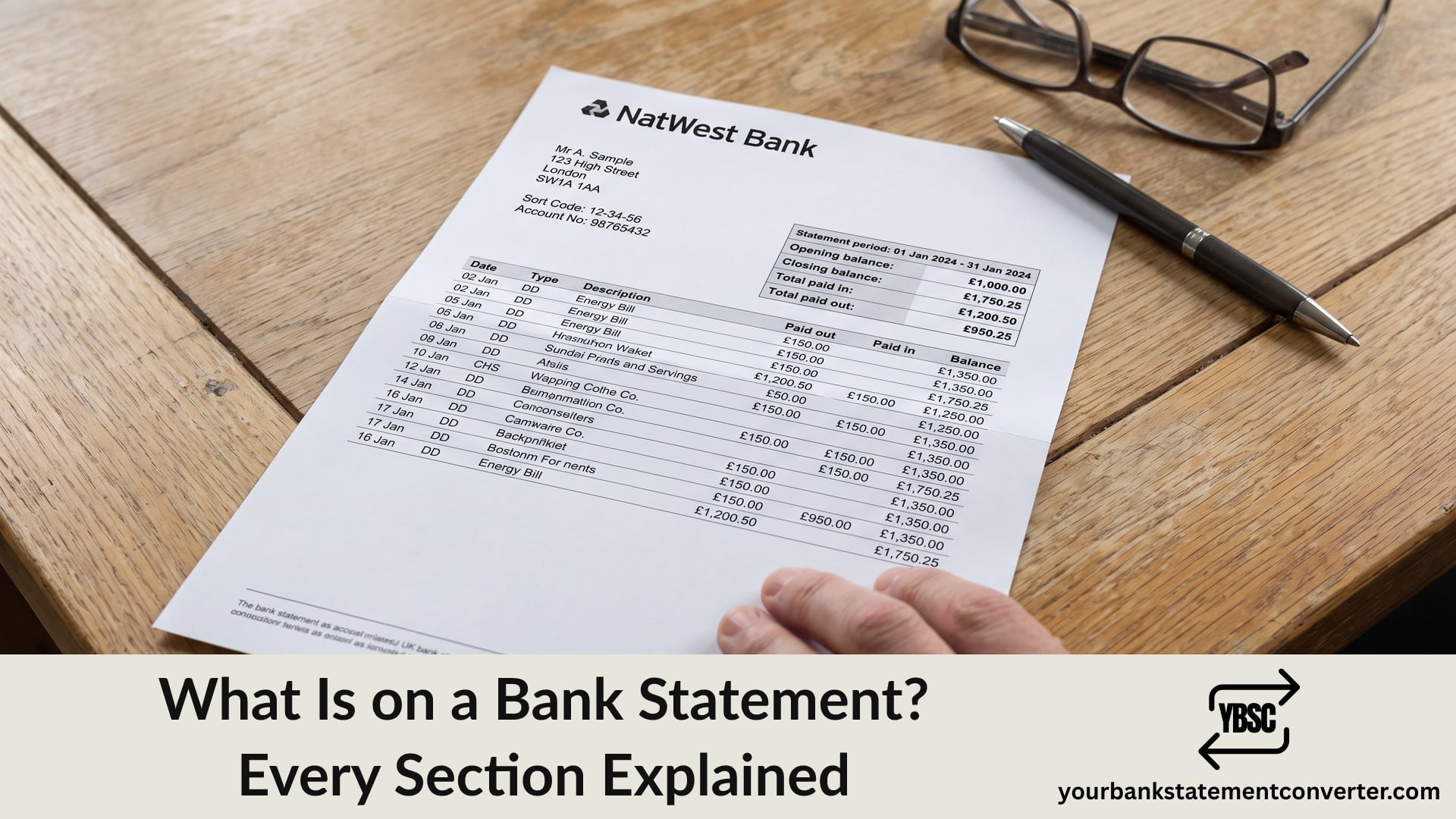
The header identifies the account. Next comes the summary, giving the totals. Below that, the transaction table lists individual movements. Finally, the footer carries legal and contact details.
Once you know the blocks, any bank’s layout becomes readable, even one you have never seen before.
The Header: Who the Statement Belongs To
The top of the page identifies the account holder and the account itself. Expect to find:
- Your name and address as registered with the bank
- The bank’s name and often the branch
- Your sort code, six digits identifying the branch
- Your account number, eight digits identifying the account
- An IBAN on many statements, used for international payments
- The statement number and page number
This is the section that makes a statement work as proof of address. Because your name and address sit alongside a regulated institution’s details, letting agents and employers accept it as evidence you live where you say.
The Statement Period and Balances
Below the header sits the reporting window and the totals. This part is short but it does the heavy lifting.
- Statement period, the start and end dates the document covers
- Opening balance, the money in the account on day one
- Closing balance, the money left on the final day
- Total paid in and total paid out across the period
Lenders care about this section more than any other. They ask for three or six consecutive months precisely so they can see whether the closing balance trends up or down.
Watch the dates carefully when you are asked for statements. A gap between one period ending and the next beginning usually means a missing document, and that will hold up an application.
The Transaction Table: Where the Detail Lives
This is the largest section and the one people mean when they ask what is on a bank statement. Each row is one movement of money, and each column answers a different question.
- Date tells you when the transaction cleared, which is not always when you spent
- Type is a short code describing how the money moved
- Description names the party involved
- Paid out and Paid in carry the amount
- Balance shows the running total after that row
The type code is the column that confuses people most. DD means Direct Debit, STO a standing order, BGC a bank giro credit and ATM a cash withdrawal. Our guide to statement abbreviations covers the full set.
The description trips people up almost as often. Banks record the registered company name, so a familiar shop can appear under a name you have never heard of. That is why so many people end up searching for an entry they do not recognise.
The Footer: Small Print That Occasionally Matters
The bottom of the page carries the bank’s registered details, its regulator, and often a note about the Financial Services Compensation Scheme.
Most of the time you can ignore it. It becomes relevant when you need to prove which legal entity holds your money, which comes up in probate, bankruptcy and some business applications.
Reading a Statement Without Scrolling Through PDFs
Knowing what is on a bank statement is one thing. Working across twelve of them is another, particularly when you are totalling a category or hunting one recurring charge.
Our bank statement converter turns PDF statements into clean, searchable spreadsheets. Filter by description, sort by amount, or total a whole year of one merchant in seconds instead of reading page by page.
Conclusion
To sum up, what is on a bank statement breaks into four blocks. A header identifies the account, a summary gives the period and balances, a transaction table carries the detail, and a footer holds the legal small print.
The transaction table does most of the work. Its type code and description columns also cause most of the confusion. Read those two together and almost every unfamiliar entry explains itself.
FAQ
1.What is on a bank statement?
A statement carries your name and address plus the bank’s details, your sort code and account number. It also shows the statement period, the opening and closing balances, and a table of every transaction with its date, type, description and amount.
2.Does a bank statement show my full account number?
Usually yes on a paper or PDF statement, alongside your sort code. Online summaries sometimes mask part of it, which is why lenders normally ask for the full PDF rather than a screenshot.
3.How many months of statements do lenders ask for?
Three months is typical, and six is common for mortgages or self-employed applicants. They must be consecutive, with no gaps between one period ending and the next beginning.
4.Why does a shop appear under a different name on my statement?
Banks record the registered legal entity that collected the payment, not the trading name above the door. Payment processors add another layer, which is why some descriptions look unfamiliar.
5.Is a bank statement proof of address?
Often, yes. It shows your name and address, issued by a regulated institution. Many letting agents, employers and government services accept a recent statement as evidence of address.
6.What is the difference between the opening and closing balance?
The opening balance is what sat in the account on the first day of the statement period. Closing balance means what remained on the last day, after every transaction in between.