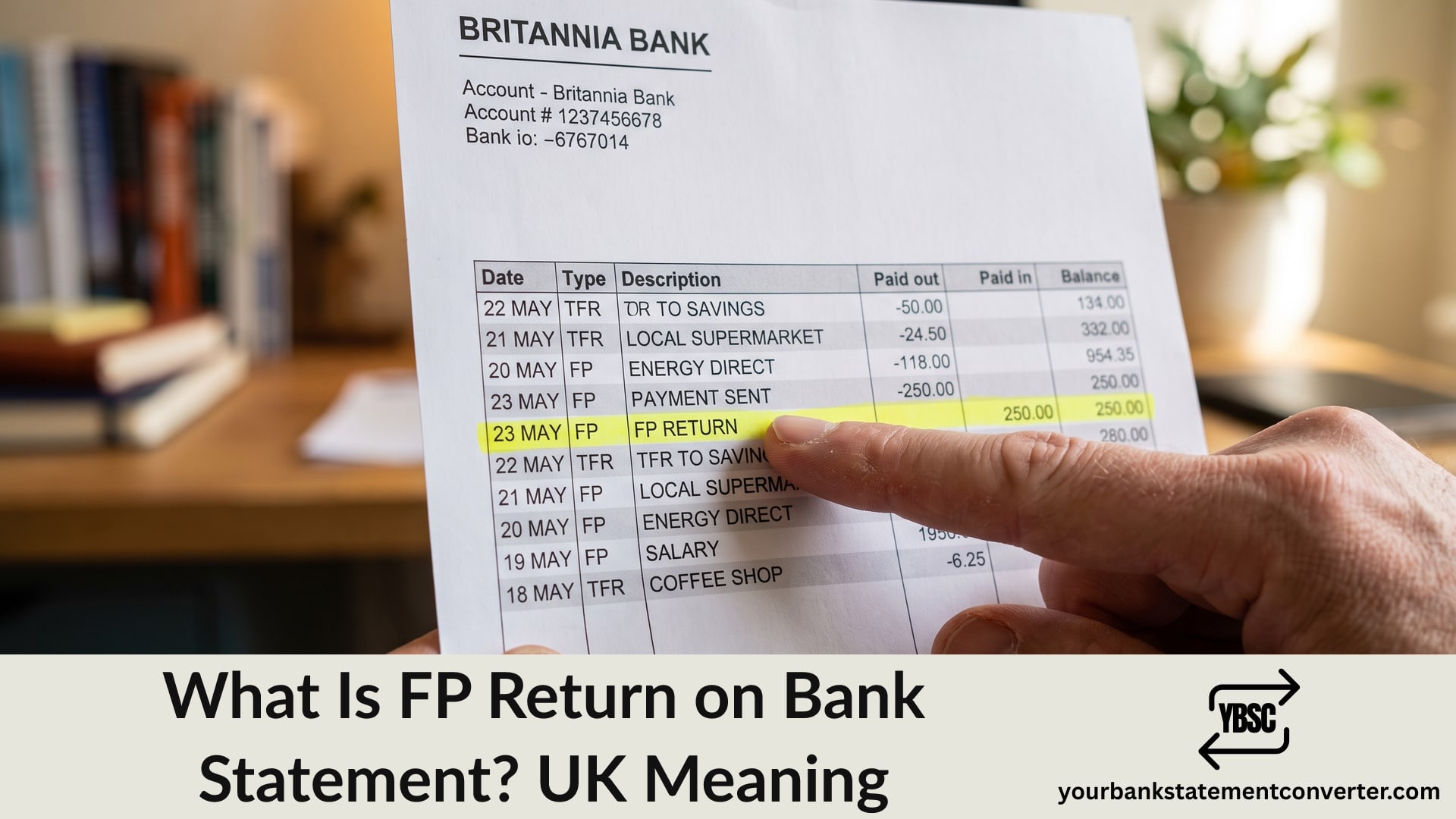
Money you sent reappearing in your account is confusing rather than reassuring, because nothing explains why. FP Return on a bank statement means a Faster Payment you made could not be delivered and has come back.
This guide explains the abbreviation, the reasons a transfer bounces, and what to do before you try sending it again.
Key Takeaways
- FP means Faster Payment, the UK system for near-instant transfers.
- A return is money coming back because the payment could not be completed.
- The most common cause is wrong account details.
- Returns usually arrive within a few hours to a few working days.
- Check the details before resending, or the same payment bounces twice.
What FP Return Means
Split the abbreviation and it becomes clear.
FP stands for Faster Payment, the scheme handling most UK bank transfers between accounts. Payments normally arrive within seconds.
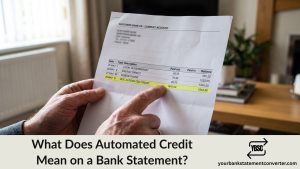
Return means the receiving bank sent it back. The money leaves your account, fails to land, then reappears, which is why an FP Return on bank statement entry always sits alongside a matching outgoing payment. Our guide to automated credit explains the other ways money arrives electronically.
Depending on your bank you may see FP RETURN, FASTER PAYMENT RETURN, FPR or a reference alongside it. Our guide to statement abbreviations covers the related codes.
Why a Faster Payment Gets Returned
Six reasons account for almost all of them.
Incorrect account number or sort code. The most common cause by far. Where the details do not match a live account, the payment cannot be delivered.
A closed account. The details were valid once, but the account has since closed.
A name mismatch. Confirmation of Payee checks the name against the account. A mismatch normally warns you before sending, though some payments still fail afterwards.
An account that cannot receive payments. Some savings accounts, mortgage accounts and restricted accounts do not accept inbound Faster Payments.
A limit exceeded. Either your sending limit or the recipient’s receiving limit.
A block on the receiving account. A frozen or restricted account rejects incoming money.
How Long It Takes to Come Back
Timing varies, which is what causes the anxiety.
Many returns happen within hours, particularly where the account details are simply invalid.
Others take one to three working days, especially where the receiving bank has to investigate before rejecting.
Occasionally a return takes up to a week. Where money has not reappeared after that, contact your bank rather than waiting longer.
Note that the money is not lost during this window. It sits in the clearing process rather than in either account.
What to Do Before Sending Again
Resending the same details produces the same result, so check first.
Confirm the account number and sort code directly with the recipient, ideally by voice rather than message.
Check the account type. Ask whether the account can receive Faster Payments, since some cannot.
Match the name exactly. Use the account holder’s name as the bank holds it, not a shortened or trading version.
Check the amount against limits. Large transfers may exceed a daily limit, in which case splitting the payment or using CHAPS works better.
Look for a reason code on your statement or in your banking app, since some banks state why the payment failed.
An Important Fraud Warning
Worth knowing, because this scenario is exploited.
If someone contacts you saying a payment failed and gives you different account details to use, treat it as a scam until proven otherwise. Redirected payment fraud works exactly this way, often targeting house purchases, invoices and deposits.
Always verify new details by phoning the recipient on a number you already had, never one supplied in the message asking you to change them.
Keeping Track of Failed Payments
A returned payment produces two entries, which makes reconciling an account harder, particularly for a business matching payments to invoices.
Our bank statement converter turns PDF statements into clean, searchable spreadsheets. Filter for FP entries and every payment and its matching return line up together, so you can see which transfers actually completed.
Conclusion
To sum up, FP Return on a bank statement means a Faster Payment came back because it could not be delivered, most often due to incorrect account details or a closed account. The money returns within hours to a few working days and is never lost in the meantime. Verify the details by voice before resending, and treat any message supplying replacement account details as a likely scam.
FAQ
1.What is FP Return on a bank statement?
FP stands for Faster Payment, and a return means the payment could not be delivered so the money came back to your account. You will see both the outgoing payment and a matching credit.
2.Why was my Faster Payment returned?
Usually because the account number or sort code was wrong, the account has closed, the name did not match, or the receiving account cannot accept Faster Payments.
3.How long does an FP Return take?
Often within hours, sometimes one to three working days. If the money has not reappeared after about a week, contact your bank.
4.Is my money safe while it is being returned?
Yes. The payment sits in the clearing process rather than being lost. It leaves your balance and reappears once the return completes.
5.Will I be charged for a returned Faster Payment?
Personal accounts are not usually charged. Some business accounts apply a fee for failed payments, so check your account terms.
6.Someone says my payment failed and sent new bank details. What should I do?
Treat it as a likely scam. Phone the recipient on a number you already had to verify. Redirected payment fraud works precisely by supplying replacement account details after a supposed failure.