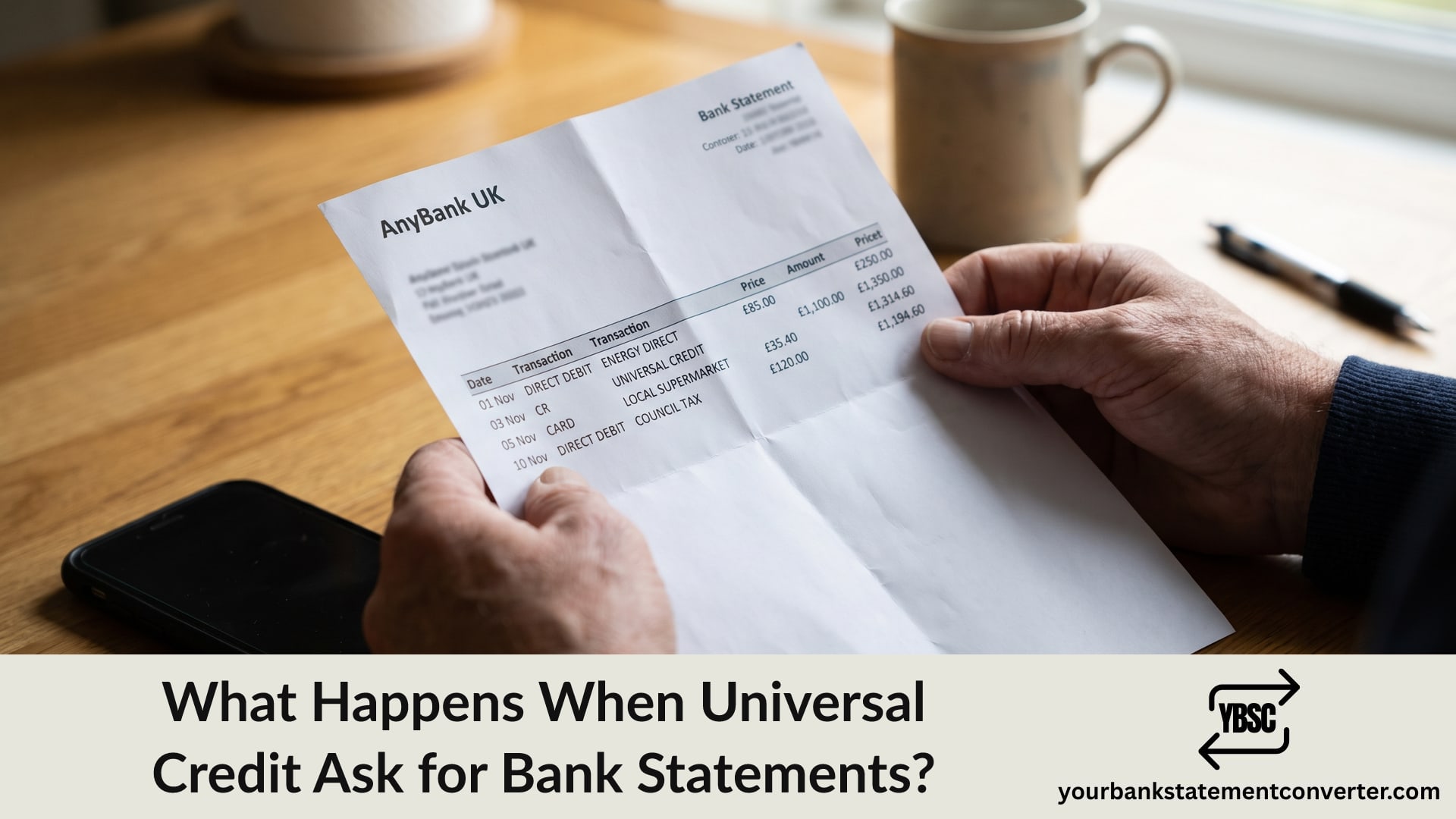
A journal message asking for statements is alarming precisely because it does not explain itself. Understanding what happens when Universal Credit ask for bank statements removes most of the worry, because the process is more routine than it feels.
This guide walks through the sequence from request to outcome, what the DWP does with the documents, and what to do if you cannot meet the deadline.
Key Takeaways
- Most requests are routine reviews, not accusations.
- You normally get a deadline of one to two weeks through your journal.
- The DWP checks capital and undeclared income, not your spending habits.
- Missing the deadline can lead to your claim being suspended.
- Most reviews end with no change to your award.
Why the Request Arrives
Requests follow a trigger rather than arriving at random.
- A routine review, which happens periodically on longer claims
- A reported change, such as moving home, a new job or a relationship change
- Data from another source that does not match your claim
- A capital query, where something suggests savings near a threshold
- A referral, including anonymous reports
Receiving one does not mean you are suspected of anything. Long claims get reviewed as a matter of course.
The Sequence, Step by Step
Knowing the shape of it makes the wait easier.
You receive a message in your journal, or occasionally a letter or phone call. It states the period wanted and the deadline.
You upload or send the statements, through your journal, at a Jobcentre appointment, or by post.
A case manager reviews them, checking against what you declared.
They may ask follow-up questions about specific entries, usually large or regular ones.
A decision follows. Most commonly nothing changes. Where something does not match, your award may be adjusted, and an overpayment may be recovered.
Timescales vary, but a straightforward review usually concludes within a few weeks.
What They Actually Check
Narrower than most people fear, and worth repeating.
Capital across all your accounts. Between £6,000 and £16,000 reduces your award on a sliding scale, and above £16,000 normally ends entitlement.
Undeclared income, meaning money arriving that you have not reported. PAYE earnings report automatically, so the focus is on self-employed takings, rent from a lodger or regular payments from others.
Household circumstances, where entries suggest your situation differs from what you declared.
They do not assess your spending. Our guide to what Universal Credit look for on bank statements covers this in detail, and does a bank statement show what you bought explains why individual purchases are invisible anyway.
If You Cannot Meet the Deadline
Do not simply let it pass, because that is what causes real problems.
Message them through your journal explaining the difficulty and asking for more time. A genuine reason, such as waiting for a bank to post copies, is normally accommodated.
Send what you have while you wait for the rest, so they can see you are cooperating.
Ask your bank for copies as early as possible, since older statements can take days and may carry a fee.
Ignoring a request can lead to suspension, and payments stopping is far harder to unwind than an extension is to arrange.
If Something in Your Statements Looks Wrong
Explain it before you are asked, in your journal, in writing.
Large one-off deposits with an innocent explanation are the common case: a tax refund, an insurance payout, money held for a family member, or a loan. Each is straightforward once explained and looks evasive once queried.
Where money in your account genuinely belongs to somebody else, say so immediately with evidence. That situation is not unusual, but it does need documenting.
Preparing What You Send
Send complete, unedited statements for every account, including ones you rarely use. Capital is assessed across all of them, and an omitted account causes far more trouble than anything likely to be in it.
Never redact anything. Our guide to what a redacted bank statement means explains why benefits reviews are one of the situations where editing is not allowed.
Before sending, it helps to read them as an assessor would. Our bank statement converter turns PDF statements into clean, searchable spreadsheets, so you can total your deposits, spot a regular credit you had forgotten, and prepare an explanation in advance.
Conclusion
To sum up, what happens when Universal Credit ask for bank statements is a review rather than an accusation: you upload statements for the period requested, a case manager checks capital and undeclared income against your claim, and most reviews end with no change. Send every account complete and unedited, explain anything unusual in your journal upfront, and message them rather than missing the deadline, since an unanswered request can suspend your claim.
FAQ
1.What happens when Universal Credit ask for bank statements?
You receive a journal message giving the period and a deadline. After you send the statements, a case manager checks them against your claim. Most reviews conclude with no change to your award.
2.How long do I have to provide them?
Usually one to two weeks, stated in the request. If you need longer, message through your journal and ask, since genuine reasons are normally accommodated.
3.Does a request mean I am being investigated?
Not usually. Most requests are routine reviews, triggered by the length of your claim or a change you reported rather than by suspicion.
4.What if I miss the deadline?
Your claim can be suspended and payments stopped. Message through your journal before the deadline rather than after, explaining the difficulty.
5.Do I have to send statements for every account?
Yes. Capital is assessed across all your accounts, so omitting one, even a rarely used one, causes significantly more problems than including it.
6.How long does the review take?
A straightforward review usually concludes within a few weeks. Follow-up questions about specific entries can extend it, which is why explaining anything unusual upfront helps.