
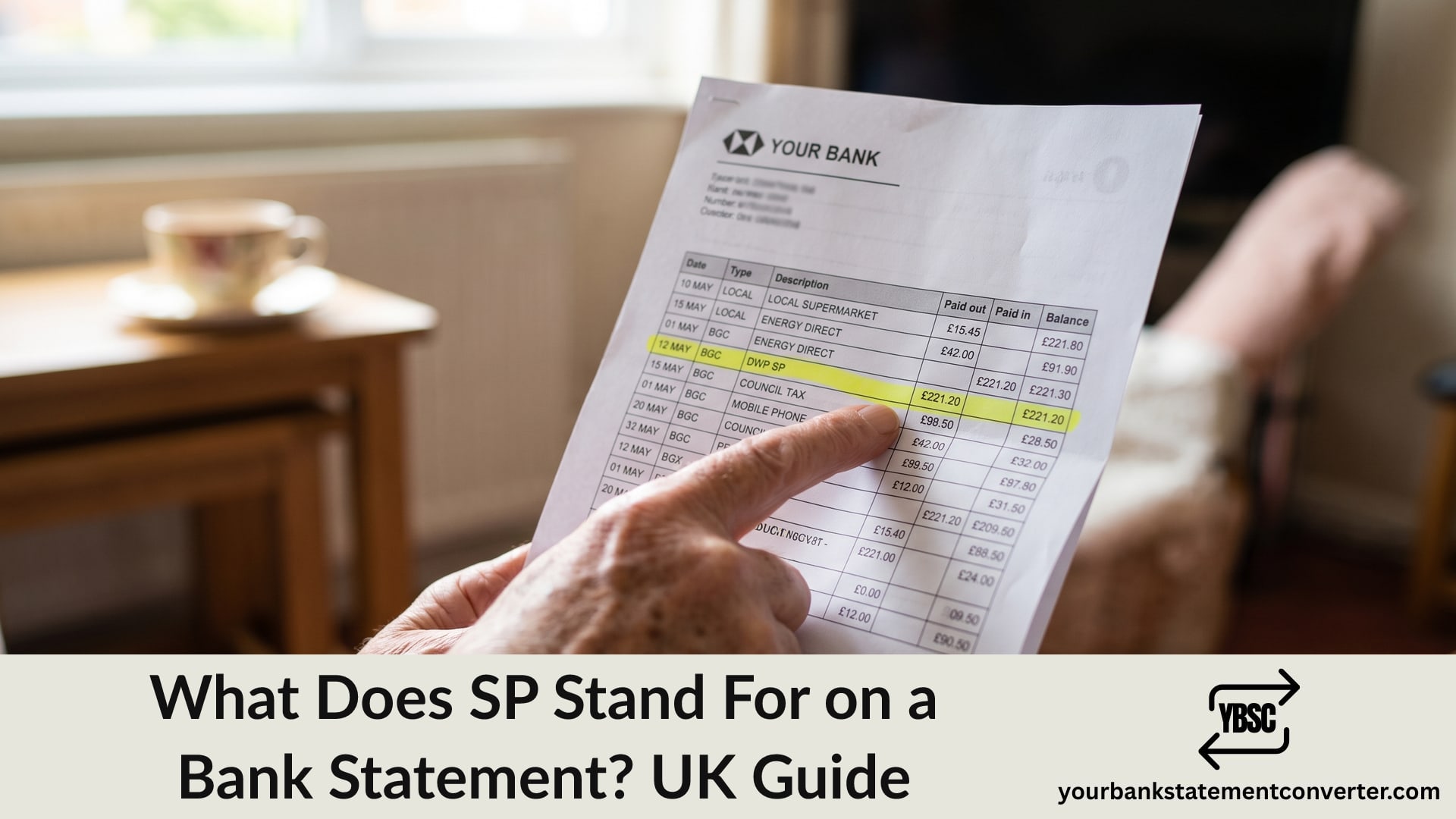
Two letters carry a surprising number of meanings, and your bank publishes none of them. So what does SP stand for on a bank statement? Start with one question: is the money coming in or going out?
That single test separates the likely explanations, and this guide walks through each of them plus how to confirm which applies to you.
Key Takeaways
- SP has no single official meaning. It appears on no major UK bank’s published code list.
- Beside money paid in, SP most often relates to a State Pension payment from the DWP.
- Beside money paid out, it usually abbreviates a company name or a service provider.
- Written as
SP*, it is a payment processor prefix and the merchant follows the asterisk. - The direction of the money narrows it down in seconds.
What Does SP Stand For on a Bank Statement?
Four explanations cover nearly every case.
State Pension. Credits from the Department for Work and Pensions often carry SP in the reference. These arrive every four weeks rather than monthly, which is itself a useful clue. Our guide to DWP SP on a bank statement covers this specific case in detail.
A company’s initials. Sports clubs, service providers, software firms and letting agents all abbreviate themselves on Direct Debits.
A payment processor prefix. Entries shaped like SP* come from a gateway. The letters identify the processor and the text after the asterisk names the merchant.
Standing payment or service provider. Some banks and utilities use SP descriptively, though this is less common than the explanations above.
Why Your Bank Does Not Publish SP as a Code
UK banks document abbreviations for transaction types, meaning how money moved. Barclays publishes codes such as BGC, STO, DDR and CHAPS, and our guide to statement abbreviations collects the common set.
SP does not belong to that vocabulary. It is either part of a reference field or the name of a party, and banks publish lists of neither.
Because no standard forces banks to agree, check your own bank’s help pages before trusting any general list you find.
The Test That Narrows It Down
Direction first, then rhythm. Those two checks resolve most entries.
Money in, every four weeks. Almost certainly a State Pension payment. That four-weekly cycle is distinctive, because most other income arrives monthly.
Money in, irregularly. More likely a refund, or a payment from a company whose name starts with those letters.
Money out, same amount monthly. A subscription, membership or service contract.
Money out, varying amounts. Card payments to a merchant using SP as a prefix or an abbreviation.
How to Identify an SP Entry You Cannot Place
Take these in order.
Read the untruncated description. Banking apps shorten text aggressively. The PDF statement or online banking usually shows a longer reference, sometimes including a fuller name or the text after an asterisk.
Check the payment cycle. Four-weekly points strongly at a DWP payment. Monthly on a fixed date points at a Direct Debit.
Match the amount against your commitments. A steady figure suggests something you signed up to. Compare against subscriptions you may have forgotten.
Ask who else uses the account. Joint holders and second cardholders generate entries nobody else recognises.
Then contact your bank. Give them the date, amount and exact description. They see the underlying record, which no amount of searching will reveal.
When to Treat It as Unrecognised
Most SP entries turn out to be legitimate. Act promptly when one fails every check above.
Tell your bank you do not recognise the transaction, rather than asking what it is. That phrasing opens a dispute, and card disputes carry time limits.
Do not cancel a Direct Debit before you know what it pays for. Stopping an active agreement without settling the balance can leave you in arrears with a company you have not identified.
Checking Every SP Entry Together
One entry is quick to check. Establishing whether the same SP payment has been taken every month for two years means reading twenty-four statements line by line.
Our bank statement converter turns PDF statements into clean, searchable spreadsheets. Search the description column for SP, and every matching entry lines up with its date and amount, so the pattern becomes obvious at a glance.
Conclusion
To sum up, asking what does SP stand for on a bank statement has no single answer, because no UK bank publishes it as a standard code. A four-weekly credit usually relates to a State Pension payment from the DWP.
Against a debit, treat it as a company abbreviation, or as a payment processor prefix where an asterisk follows. Check the direction and the payment cycle first, then ask your bank if the entry still does not resolve.
FAQ
1.What does SP stand for on a bank statement?
There is no official UK definition. Beside money paid in, it commonly relates to a State Pension payment. Beside money paid out, it is usually a company abbreviation or a payment processor prefix.
2.Is SP always the State Pension?
No. That is the most common meaning for a credit arriving every four weeks, but SP beside a payment out is far more likely to be a company’s initials.
3.How often is the State Pension paid?
Every four weeks in most cases, paid in arrears. That four-weekly rhythm is a useful way to tell a pension credit apart from monthly income.
4.What does SP with an asterisk mean?
An asterisk marks a payment gateway prefix. The letters before it identify the processor, and the text after it names the merchant you actually paid.
5.Is SP an official banking code?
No. Barclays and other UK banks do not list SP among their published abbreviations, which cover transaction types such as BGC, STO and DDR rather than references or company names.
6.What should I do about an SP charge I do not recognise?
Check the payment cycle and who else uses the account, then contact your bank with the date, amount and full description. Say you do not recognise it, because that opens a dispute and those carry time limits.