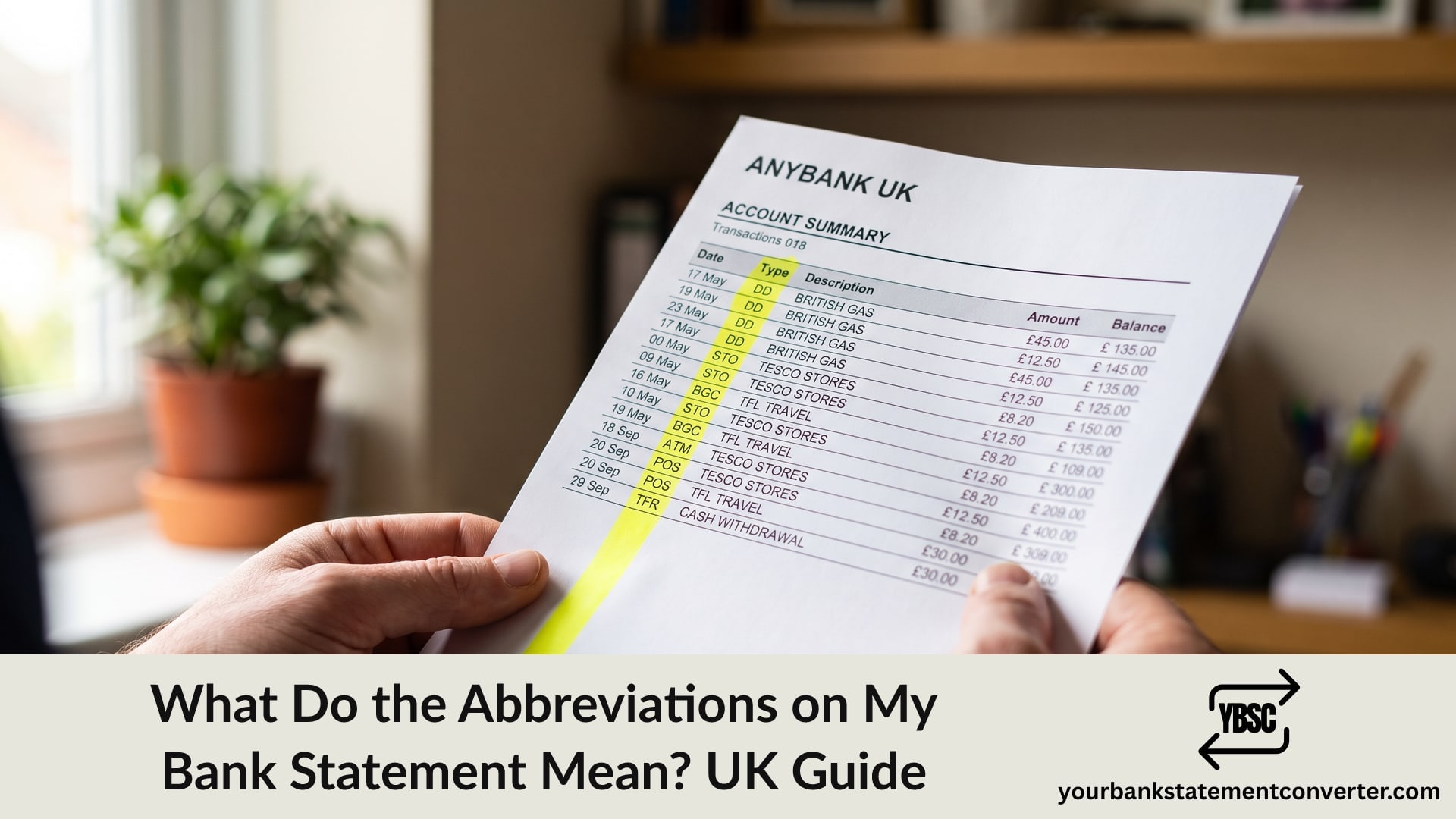
Two or three letters sit in the Type column next to every line. None of them explain themselves. Wondering what the abbreviations on my bank statement mean? They are shorthand your bank uses to record how the money moved.
This guide decodes the common UK codes. It also explains why the same letters mean different things at different banks, and shows you how to identify any code that is not on the list.
Key Takeaways
- Statement abbreviations describe the payment method, not the merchant.
- There is no industry standard. Barclays, HSBC and NatWest all use slightly different sets.
- The most common UK codes are BGC, STO, DDR, CHAPS, DR and CR.
- A code followed by an asterisk, such as
PYD*orIC*, is usually a payment processor prefix, not a bank code. - If a code is not on your bank’s published list, ask your bank. Only they can trace it to a specific transaction.
Why Do Banks Use Abbreviations at All?
Space. A printed line holds a date, a short description, an amount and a balance. That leaves room for only two or three letters to carry the transaction type.
Those letters answer one question: how did this money move? Direct Debits, standing orders, card payments and branch deposits all look alike once they hit your balance. The code tells them apart.
Importantly, the code says nothing about who you paid. That comes from the description text beside it, which is often a company’s legal name rather than its trading name.
The Common UK Bank Statement Abbreviations
Barclays publishes its own list, and most UK banks overlap heavily with it. These are the codes you will meet most often:
- APR Annual Percentage Rate, relating to credit interest
- BBP bill payment
- BGC bank giro credit, money paid in over a counter or by another bank
- CHAPS Clearing House Automated Payment System, a same-day transfer
- CRE or CR a credit, meaning money in
- DDR or DD Direct Debit
- DR a debit balance, meaning the account is overdrawn
- STO standing order
- REV a reversal, where a standing order or Direct Debit has been recalled
- REM remittance, a cheque credited from another branch or bank
- UNP unpaid
- IMO International Money Order
- CDL Career Development Loan
- ISA Individual Savings Account
- IBAN International Bank Account Number
Alongside those, you will see card and cash codes such as ATM for a cash machine, POS or CP for a card payment, and TFR for a transfer between accounts.
We cover several of these in detail already, including BGC, CR, DR and point of sale.
Why the Same Abbreviation Means Different Things
Here is the part that catches people out. No regulator sets these codes. Each bank chooses its own, so the same two letters can carry different meanings depending on who you bank with.
For example, some banks use CR for a credit while others use it for a credit card account. Some use TFR for any internal transfer, while others reserve it for transfers between your own accounts only.
Building societies and utility providers add their own layer too. A water company or a gym can appear under an abbreviation that means nothing outside that organisation.
So when a code looks unfamiliar, check your own bank’s published list first rather than a general one. Most UK banks keep an abbreviations page in their online help.
What About Codes With an Asterisk?
A code followed by an asterisk works differently. Entries such as PYD*example.com or IC*something are not bank codes at all.
Instead, they come from a payment processor. The letters before the asterisk identify the gateway that handled the payment, and the text after it identifies the merchant. This is why the name often looks nothing like the shop you visited.
If you do not recognise one of these, the text after the asterisk is your best lead. Searching that string usually identifies the business faster than contacting your bank does.
How to Identify an Abbreviation Your Bank Does Not List
Most abbreviations on my bank statement questions resolve in two steps rather than ten, so work through these in order.
Read the full description first. Banking apps often truncate the text. The same transaction viewed in online banking, or on the PDF statement, frequently shows a longer description including a location or reference.
Match the amount and date to something you did. A recurring monthly amount points to a subscription or Direct Debit. Round numbers usually mean a cash withdrawal.
Check who else uses the account. A joint holder or second cardholder produces entries you will not recognise.
Then contact your bank. Give them the date, amount and code. They can see the underlying transaction record, which you cannot.
Reading Every Code at Once Instead of One at a Time
Decoding a statement line by line works for a single mystery charge. It stops working when you want the whole picture. Think of every Direct Debit you pay, or every card payment to one merchant across a year.
Our bank statement converter turns PDF statements into clean, searchable spreadsheets. Sort by the type column, then group every STO or DDR together. Your recurring commitments appear in one view instead of across months of PDFs.
Conclusion
To sum up, the abbreviations on my bank statement mean the payment method, not the merchant. The common UK set runs from BGC and STO to DDR, CHAPS, DR and CR.
Because no standard forces banks to agree, check your own bank’s list before trusting a general one. Treat any code carrying an asterisk as a payment processor prefix, then read the text after it. Anything still unexplained is worth a call to your bank, since only they can trace the entry.
FAQ
1.What do the abbreviations on my bank statement mean?
Each one records the payment method. BGC means a bank giro credit, STO a standing order, DDR a Direct Debit. None of them tell you which company took the money; the description text does that.
2.Is there a standard list of bank statement codes in the UK?
No. Each bank sets its own abbreviations, so the same letters can mean different things at different banks. Check your own bank’s published list first.
3.What does an asterisk in a statement code mean?
An asterisk usually marks a payment processor prefix, as in PYD*example.com. The letters before it identify the gateway and the text after it identifies the merchant.
4.Why is the company name on my statement different from the shop?
Banks record the legal entity that collected the payment. That is often a registered company name or a payment processor rather than the trading name on the shop front.
5.What should I do about a code I cannot identify?
Compare the amount and date against your own spending, check who else holds a card on the account, then contact your bank with the details. They can trace the transaction record directly.
6.Can I see all my Direct Debits in one place?
Yes. Convert your statements to a spreadsheet, then filter the type column. Grouping every DDR or STO entry together is far quicker than reading each month separately.