
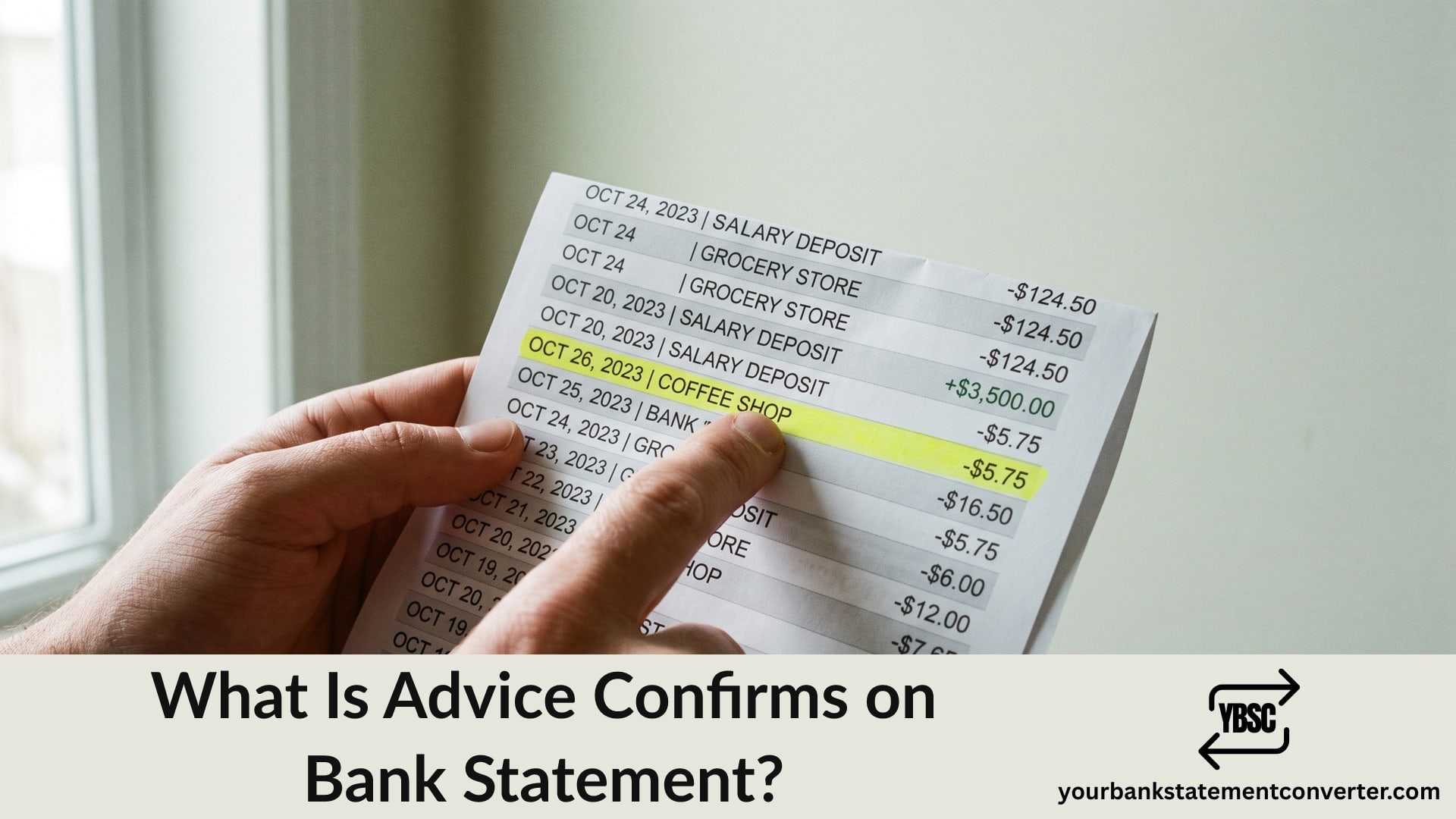
Not every unfamiliar phrase on a statement is a company. Advice Confirms on a bank statement is banking language rather than a merchant name, and it usually signals a payment arriving through a clearing system rather than an ordinary transfer.
This guide explains what “advice” means in banking, which payment types produce the wording, why it is not the same as the money landing, and what to check when the amount matters.
Key Takeaways
- “Advice” is the banking word for a notification about a transaction.
- The wording usually accompanies a CHAPS or wire payment, often a large one.
- It signals that a separate confirmation was sent alongside the payment.
- It is not a company name, so searching for a business gets you nowhere.
- Check the available balance, because an advice is not proof the funds have cleared.
What “Advice” Means in Banking
One definition clears up most of the confusion.
In banking, an advice is simply a notification about a transaction. A payment advice tells the recipient that money is on its way or has been sent. It typically carries the sender’s details and a reference.
So an Advice Confirms on bank statement line is your bank saying, in shorthand, that the payment arrived with that notification attached. The phrase describes how the payment was communicated, not who sent it.
That is why searching the phrase as a company name leads nowhere. It belongs with the codes and shorthand our guide to what the abbreviations on a bank statement mean works through.
Which Payments Produce an Advice Confirms on Bank Statement Entry
Certain payment types carry an advice as standard.
- CHAPS payments, the UK’s same-day high-value transfer system
- International or overseas transfers arriving through correspondent banks
- Wire payments more generally, particularly business to business
- Large one-off credits such as a house sale completion or a settlement
Value and formality are the common thread. Routine Faster Payments between personal accounts rarely produce this wording. A solicitor completing a property purchase almost always does.
Money In, Not Money Out
Check the column, because it settles what you are looking at.
The phrase nearly always accompanies a credit, meaning money arriving. Where the amount sits in your paid-in column, nothing has been taken from you. The question becomes who sent it rather than who charged you.
Our guide to what are debits and credits on a bank statement explains how to read the two columns where a layout is unfamiliar.
An Advice Is Not the Same as Cleared Funds
This distinction matters most in exactly the situations where the money is large.
A notification says a payment has been sent or is on its way. Whether the funds are available to spend is a separate question. Your balance answers that, not the wording on the entry.
Before relying on the money:
- Check your available balance, not just the entry in the list
- Check for a pending marker, which some banks show alongside
- Allow for cut-off times, since CHAPS operates within set hours on working days
- Confirm with your bank where a same-day onward payment depends on it
Property completions, vehicle purchases and business settlements all turn on this point. Sending money onward before the funds clear is how people end up overdrawn.
Finding Out Who Sent It
The advice usually carries the answer, even when the statement does not.
Your bank holds the payment details, including the sender’s name, their bank and any reference. Ask for them. On an incoming CHAPS or international payment, that information is normally available in full.
Where a credit is genuinely unexpected:
- Leave it untouched until you know where it came from
- Report it to your bank so they can trace it
- Never forward it on at someone else’s request
That last point is not a formality. Fraudsters send money to an account, then ask the holder to pass it elsewhere. Moving it makes you part of the chain.
When a Payment Does Not Arrive
Sometimes the advice exists and the money does not, which has its own explanations.
Compliance checks can delay incoming payments, particularly large or international ones. Banks may also hold sums arriving from overseas while sanctions and anti-money-laundering screening runs.
Ask your bank whether a payment is held rather than assuming it has failed. The sender can also request a trace through their own bank, quoting the reference on the advice.
Keeping Track of Large Credits
Big payments are few, which makes them easy to lose among hundreds of ordinary lines.
Our bank statement converter turns PDF statements into clean, searchable spreadsheets. Sort by amount and every significant credit rises to the top with its date and reference. That is the list you need when reconciling a completion, a settlement or a year’s income. Where this is a recurring job rather than a one-off, the monthly plans can be scaled up for a busy month and back down afterwards.
Conclusion
To sum up, Advice Confirms on a bank statement is banking shorthand rather than a company name. It tells you a payment arrived with a notification attached, typically a CHAPS, wire or international transfer, and almost always as money in. An advice is not the same as cleared funds, so check your available balance before relying on it, and ask your bank for the sender’s details if the credit is unexpected.
FAQ
1.What does Advice Confirms mean on a bank statement?
It is banking shorthand, not a company name. “Advice” is the industry word for a notification about a transaction, so the wording indicates a payment arrived with a confirmation attached.
2.Which payments use this wording?
Usually CHAPS payments, wire transfers and international credits, particularly larger ones. Routine Faster Payments between personal accounts rarely produce it.
3.Is it money coming in or going out?
Nearly always money coming in. Check which column the amount sits in to confirm before assuming anything has been taken.
4.Does it mean the money has cleared?
No. An advice is a notification, not confirmation that funds are available. Check your available balance rather than relying on the entry appearing.
5.How do I find out who sent the payment?
Ask your bank. They hold the sender’s name, their bank and any reference, and for incoming CHAPS or international payments that detail is normally available in full.
6.I received money I was not expecting. What should I do?
Leave it untouched and report it to your bank so they can trace it. Never forward it on at someone else’s request, since that is a common money laundering pattern.