
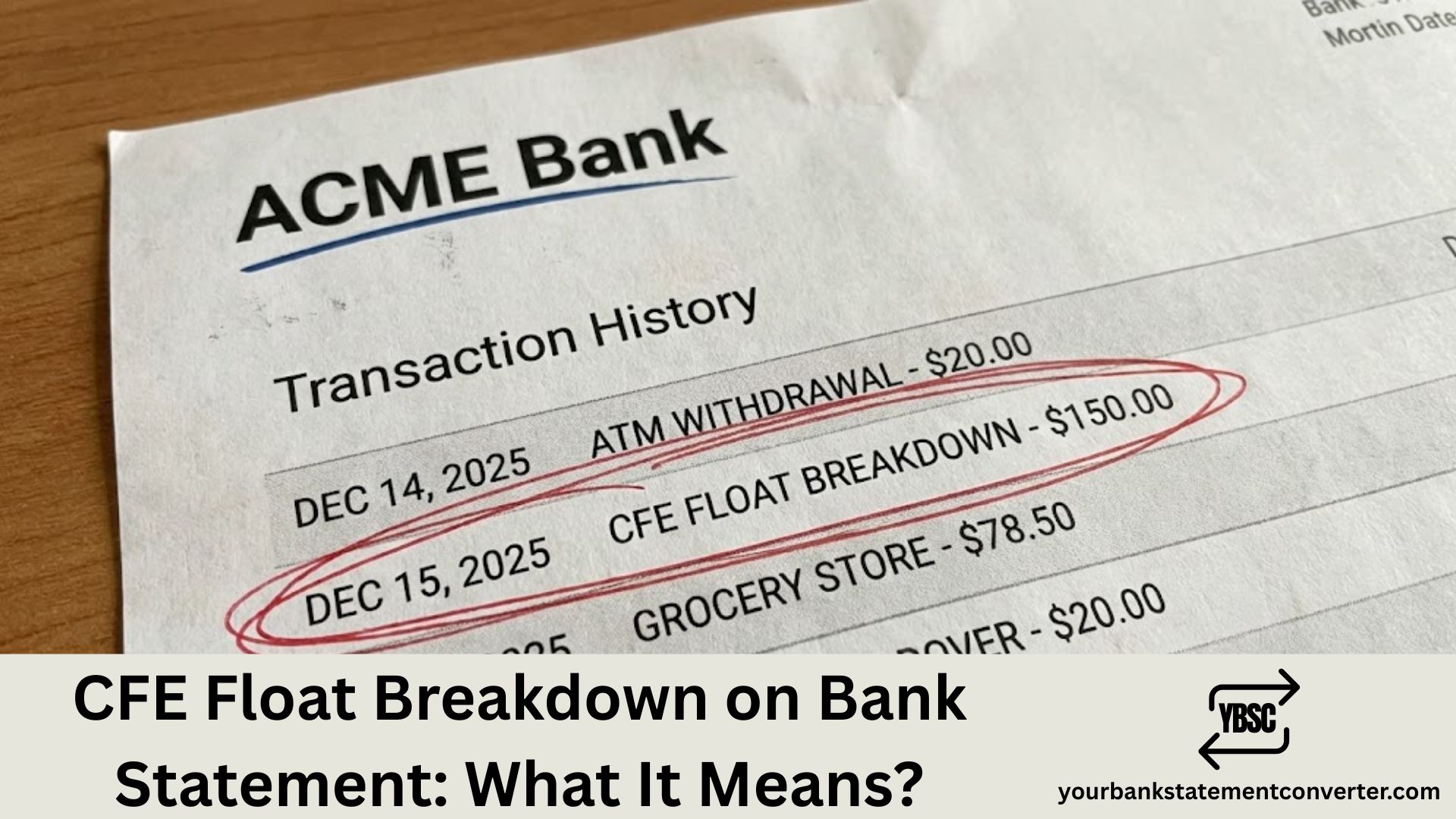
A line reading “CFE float breakdown” appears near a deposit, and your balance does not match what you paid in. If you are searching for CFE float breakdown on a bank statement, the useful part to decode is “float”, because that word has a precise banking meaning.
This guide explains what float is, what we know about the CFE label, and how to find out when your money will actually be available.
Key Takeaways
- Float means deposited money that has not cleared yet, so it counts in your balance but may not be available to spend.
- CFE is not a standard code that any bank publishes, so no official expansion exists.
- Most people who search the phrase bank with PNC, which suggests it comes from PNC’s statement format.
- A float line normally sits beside a deposit, most often a check.
- Your bank’s funds availability policy tells you exactly when held money is released.
What Does CFE Float Breakdown on a Bank Statement Mean?
The words describe how your bank releases a deposit, not a charge.
Float is the gap between when you deposit money and when your bank actually collects it from the paying bank. When you deposit a check, your bank credits it straight away but has to wait for the other bank to pay. Until it does, that money is float.
A float breakdown is simply that deposit split into parts: how much is available now and how much becomes available on later days. Banks often release part of a check at once and hold the remainder for a day or two.
CFE is the part nobody defines. No bank we could find publishes what the letters stand for, and the expansions that circulate online are guesses. The consistent signal is that people searching the phrase are overwhelmingly PNC customers, so treat it as part of PNC’s internal statement labelling rather than a term with a public meaning.
Why Your Bank Holds Part of a Deposit
In the US, federal rules known as Regulation CC set how quickly banks must release deposited funds. They allow a bank to hold part of a check deposit while it confirms the check will be paid.
Holds are more likely when:
- the check is large compared with your usual deposits,
- your account is new,
- you have redeposited a check that bounced before, or
- your account has been overdrawn repeatedly.
None of those mean anything is wrong. They are routine controls that protect you and the bank from a check that later fails.
How to Check What Your Float Line Means
You can usually work it out from your own account in a few minutes:
- Find the deposit beside it. A float line almost always relates to a check or cash deposit on the same date.
- Compare available and current balance. The difference between the two is money still in float.
- Check the release dates. Online banking often shows when held funds become available.
- Read your funds availability policy. Your bank must give you one, and it states the standard hold times.
- Ask your bank. If the numbers still do not add up, the bank can explain the exact hold on that deposit.
A float line that clears on its own within a few business days is working as intended.
When to Contact Your Bank
Most entries showing CFE float breakdown on a bank statement need no action. Contact your bank if:
- money stays held longer than your availability policy allows,
- the float figure is larger than the deposit it relates to, or
- a float line appears with no deposit you recognise.
That last case matters most, since an unexplained deposit and hold can be a sign of a fake check scam, where someone sends you a check and asks you to return part of the money.
Reconciling Deposits That Clear in Stages
Staged deposits make a statement harder to reconcile, because one deposit becomes several available amounts across different days.
Our bank statement converter turns PDF statements into clean, searchable spreadsheets, so you can line up each deposit against the amounts released later. If you match statements against your own records regularly, our guide to a bank reconciliation statement shows how, and our pricing plans charge by the page. For the wider layout, see what is on a bank statement.
Conclusion
A CFE float breakdown on a bank statement shows your bank releasing a deposit in stages while it clears. Float has a precise meaning, even though CFE itself is not publicly defined and appears to be part of PNC’s statement labelling. Match the line to a deposit, compare your available and current balances, and ask your bank if the hold runs longer than its policy says.
FAQ
1.What does CFE float breakdown mean on a bank statement?
It shows a deposit split into money available now and money still clearing. Float is deposited money the bank has not yet collected from the paying bank.
2.What does CFE stand for?
No bank publishes a definition, and nobody has confirmed the expansions you find online. The phrase appears mainly on PNC statements, so it is best treated as internal labelling.
3.Why is part of my deposit not available?
Banks can hold part of a check deposit while confirming it will be paid. US rules known as Regulation CC set limits on how long those holds can last.
4.How long does float take to clear?
Standard holds usually last one to a few business days. Your bank’s funds availability policy gives the exact timings for your account.
5.Should I worry about a CFE float breakdown line?
Usually not, since holds are routine. Contact your bank if the hold lasts longer than its policy allows or if there is no deposit you recognise.