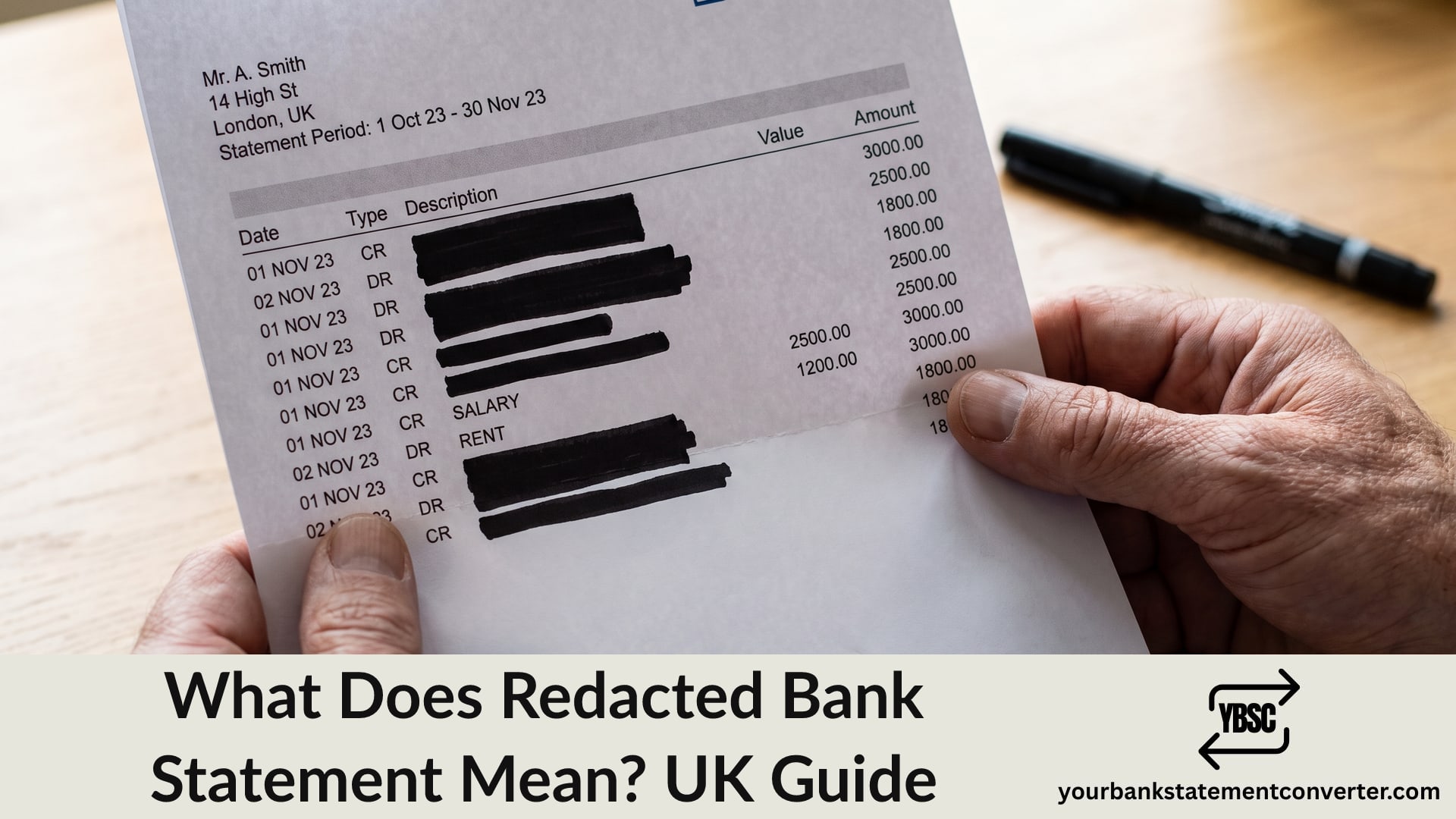
Someone asks for a statement and adds “you can redact anything sensitive”, which sounds reassuring until you have to decide what that covers. So what does redacted bank statement mean? It describes a statement where you have deliberately obscured certain information before sharing it.
This guide explains what redaction means in practice, what is safe to remove, what must always stay, and the situations where redacting is not allowed at all.
Key Takeaways
- Redaction means permanently obscuring information before you share a document.
- It is appropriate for landlords, employers and informal requests.
- It is not allowed for mortgages, lenders or HMRC, where statements must be complete.
- Never redact the account number, sort code, statement period or balances a recipient legitimately needs.
- Black boxes drawn in a PDF viewer can often be removed, so redact properly.
What Redaction Actually Means
Redaction deliberately removes specific content from a document you are handing over, leaving the rest intact and readable.
The key word is permanently. Genuine redaction strips the underlying data, not just its appearance. Cover text with a black rectangle in a PDF editor and the original often survives underneath, where anyone can recover it by copying and pasting or opening the file elsewhere.
That distinction matters more than most people realise, and we cover the safe method further down.
When Redacting Is Reasonable
Plenty of requests are legitimate but do not need your entire financial life.
- A landlord or letting agent verifying you can afford the rent
- An employer confirming bank details for payroll
- A club, school or membership body needing proof of address
- A friend or family member you are splitting a bill with
- A subject access request where a third party’s details appear
In these cases, showing your name, address, the statement period and enough income evidence is usually sufficient. Individual purchases rarely are.
When Redacting Is Not Allowed
This is the part that carries real consequences.
Mortgage applications and lending. Lenders require complete, unaltered statements. Editing one submitted for credit counts as fraud rather than a grey area, and it can invalidate an offer or lead to prosecution. Our guide to what bank statements are needed for a mortgage covers what lenders require instead.
HMRC enquiries. HMRC treats redacted records as incomplete disclosure.
Universal Credit and benefits. Assessors need to see capital and income in full. Our guide to what Universal Credit look for explains what they actually check, which is narrower than people fear.
Court proceedings and legal disclosure. Rules govern what you may withhold, and redacting on your own initiative can amount to contempt.
One rule of thumb covers it: evidence goes unaltered, while verification for a private party allows reasonable redaction.
What Should Be Redacted, and What Should Not
Where redaction is appropriate, work from these two lists.
Reasonable to redact:
- Individual transaction descriptions unrelated to what is being verified
- Third parties’ names, where someone else’s details appear
- Your full card number, which never needs sharing
- Other account numbers referenced within transactions
Should normally stay:
- Your name and address, since these prove whose statement it is
- The statement period, which proves the document is current
- Opening and closing balances, if affordability is being assessed
- Your sort code and account number, where the recipient needs to pay you
- Income entries, if income is what is being verified
Removing so much that the document proves nothing defeats the point. A landlord receiving a page of black boxes will simply ask again.
How to Redact Safely
Three methods, in order of reliability.
Use proper redaction software. A genuine redaction function deletes the underlying content rather than covering it.
Print, black out with a marker, then rescan. Crude but completely effective, because the scan contains no hidden layer.
Retype the relevant figures into a summary, and offer the full statement separately if the recipient insists.
Avoid drawing shapes over text in a PDF viewer, using highlighter tools, or cropping without flattening the file. Each leaves the original data recoverable.
Before sending, open the redacted file and try selecting and copying the hidden text. If it copies out, the redaction failed.
Sharing Only What Is Needed
Often the cleanest answer is not redacting a statement at all, but producing a summary containing only the relevant figures.
Our bank statement converter turns PDF statements into clean spreadsheets, so you can filter to the entries that matter, total your income, and share that rather than a document covered in black boxes. Where the recipient needs the original, send it unaltered.
Conclusion
To sum up, asking what does redacted bank statement mean comes down to this: a statement where you have permanently obscured selected information before sharing it. That is reasonable for landlords, employers and informal verification, but never for mortgages, lenders, HMRC, benefits or court, where altering a statement can amount to fraud. Redact using proper tools or by printing and rescanning, keep your name, the statement period and anything the recipient legitimately needs, and always check that the hidden text cannot be copied back out.
FAQ
1.What does a redacted bank statement mean?
It describes a statement where you have deliberately obscured specific information before sharing it, leaving the rest readable. Genuine redaction strips the underlying data rather than covering it visually.
2.Is it legal to redact a bank statement?
For private verification such as a landlord or employer, yes. For mortgages, lending, HMRC, benefits or court proceedings, no. Altering a statement in those contexts can amount to fraud.
3.What should be redacted from a bank statement?
Transaction descriptions unrelated to the purpose, third parties’ names, your full card number and other account numbers. Keep your name, the statement period and anything the recipient legitimately needs.
4.Can a landlord ask for unredacted statements?
They can ask, but you can reasonably redact unrelated transactions while leaving your name, address, the period and enough income evidence to show affordability.
5.How do I redact a PDF safely?
Use software with a genuine redaction function, or print the statement, black it out with a marker and rescan. Shapes drawn over text in a PDF viewer often leave the original recoverable.
6.How do I check my redaction worked?
Open the finished file and try selecting and copying the hidden text. If any of it copies out, the redaction failed and the file is not safe to send.