
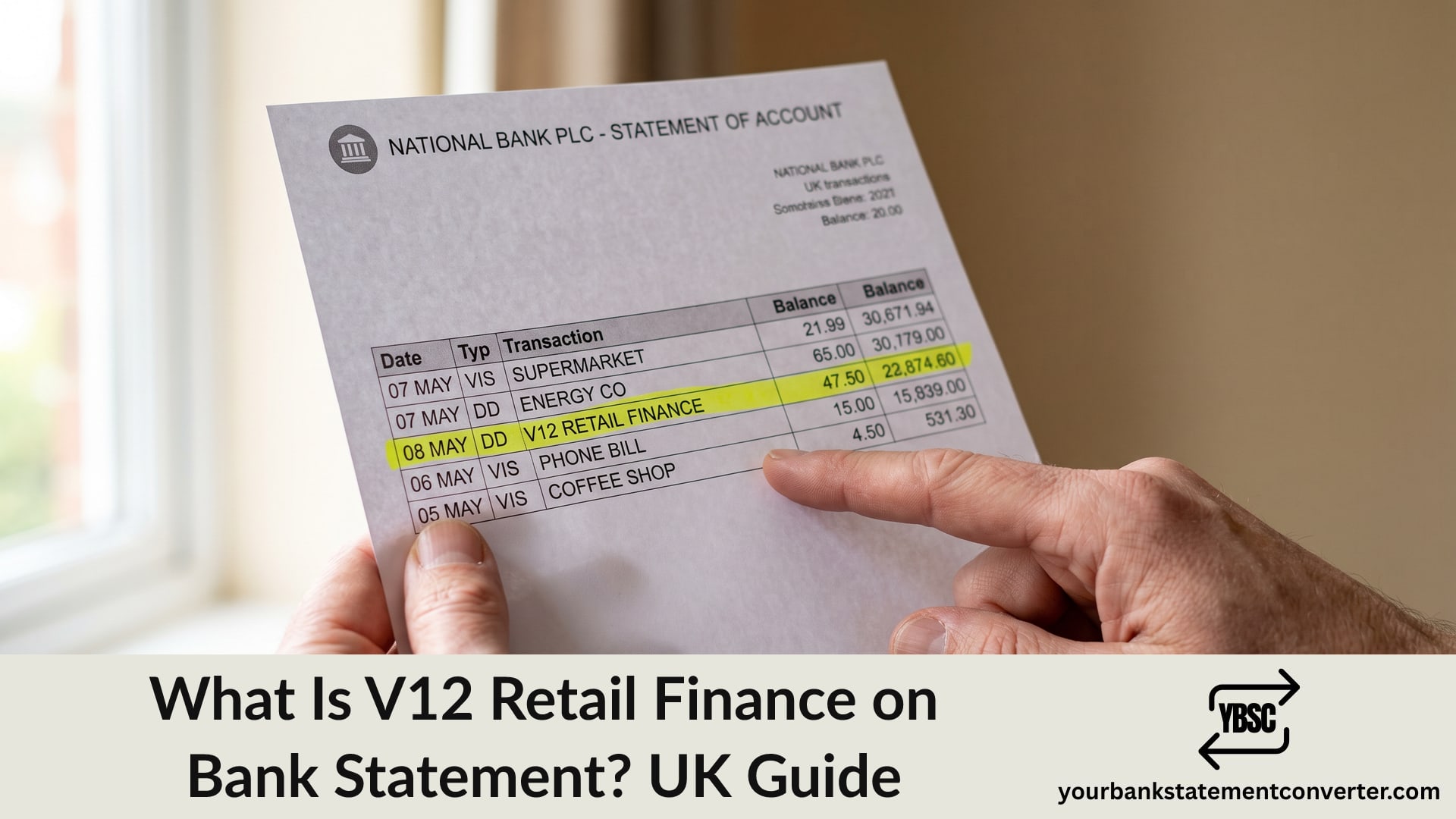
A monthly Direct Debit to a lender you do not remember choosing usually traces back to something you bought on finance. V12 Retail Finance on a bank statement is a repayment for a purchase spread over instalments.
This guide explains who they are, why the shop’s name never appears, and why this matters more than an ordinary subscription.
Key Takeaways
- V12 Retail Finance is a trading name of Secure Trust Bank PLC.
- The entry repays a purchase you financed at a retailer’s checkout.
- It is regulated by the FCA and PRA, so it is a legitimate credit agreement.
- The retailer’s name does not appear because V12 collects the payment.
- Before 2 August 2018 the same agreements showed as Secure Trust Bank PLC.
Who Is V12 Retail Finance?
V12 Retail Finance provides point-of-sale credit, meaning finance offered at the moment you buy something rather than arranged separately with a bank.
The arrangement works simply:
- You choose finance at a retailer’s checkout instead of paying in full
- V12 pays the retailer, and you repay V12
- Repayments leave by Direct Debit on a set day each month
Because V12 presents the Direct Debit, your bank records V12. The shop where you actually bought the item never appears, which is exactly why the entry looks unfamiliar.
Worth knowing: agreements taken out before 2 August 2018 showed on statements as Secure Trust Bank PLC. If you have an older agreement and the name on your statement changed, that is why.
What Purchases Usually Sit Behind It
Retail finance is offered across a wide range of sectors, which is why the amounts vary so much.
- Bicycles and e-bikes, including cycle-to-work style purchases
- Furniture and home furnishings
- Electronics and computing
- Jewellery and watches
- Musical instruments
- Home improvements and appliances
Match the monthly figure against something you bought on finance in the last few years. Multiplying the instalment by the term length usually lands close to the purchase price.
Why This Is Credit, Not a Subscription
This is the part that matters most, and where people get caught out.
Retail finance is a regulated credit agreement. You signed it at the point of purchase, often quickly, and it carries the same consequences as any other borrowing.
That means:
- Missed payments can be reported to credit reference agencies
- Arrears affect your credit file, which matters for future mortgages and loans
- Interest may apply, depending on whether the deal was interest-free
- The agreement continues even if you no longer want or use the item
Interest-free deals are common in retail finance, but they usually depend on keeping to the schedule. Missing payments can trigger interest being applied retrospectively, so the cost of a missed month can be far higher than the payment itself.
Before You Cancel the Direct Debit
Treat this as you would any loan rather than a subscription you can stop.
Cancelling the Direct Debit does not cancel the agreement. The debt remains, the missed payments become arrears, and your credit file records them.
Contact V12 first if payments are becoming difficult. Lenders would generally rather rearrange a schedule than pursue a default.
Check whether the balance can be settled early, since clearing an interest-bearing agreement early usually reduces the total cost.
Keep the agreement paperwork, which sets out the term, the APR and any interest-free period.
Where a payment leaves your account after you have settled the balance, the Direct Debit Guarantee entitles you to an immediate refund from your bank.
If You Do Not Recognise It
Work through it in order.
Think back over finance purchases, including ones made by a partner on a joint account.
Check the amount against a plausible purchase price multiplied by a typical term.
Search your email for a credit agreement, which V12 sends when the finance starts.
Contact V12 directly with the date and amount so they can identify the agreement.
Only where V12 cannot trace it should you treat the payment as unrecognised and raise it with your bank.
Our guides to PremFina and Clearpay cover two other finance arrangements that reach statements the same way.
Checking What the Finance Actually Cost
Instalments are easy to keep paying without ever comparing the total against the cash price.
Our bank statement converter turns PDF statements into clean, searchable spreadsheets. Filter the description column for V12, total the column, and compare that against what the item would have cost outright.
Conclusion
To sum up, V12 Retail Finance on a bank statement is a repayment for something you bought on finance at a retailer’s checkout, collected by V12 rather than the shop. V12 is a trading name of Secure Trust Bank and is FCA regulated, so the entry is a genuine credit agreement. Treat it as borrowing rather than a subscription: never cancel the Direct Debit to end it, because the debt remains and arrears reach your credit file.
FAQ
1.What is V12 Retail Finance on a bank statement?
It is a monthly repayment for a purchase you financed at a retailer’s checkout. V12 Retail Finance is a trading name of Secure Trust Bank PLC and collects the Direct Debit.
2.Why does the shop’s name not appear?
Because V12 paid the retailer and you repay V12. Your bank records the party collecting the money, which is V12 rather than the shop.
3.Is V12 Retail Finance legitimate?
Yes. It is a trading name of Secure Trust Bank PLC, which is regulated by the Financial Conduct Authority and the Prudential Regulation Authority.
4.Why did my statement used to say Secure Trust Bank?
Agreements taken out before 2 August 2018 showed as Secure Trust Bank PLC. The descriptor changed to V12 Retail Finance afterwards, so an older agreement may have changed name mid-term.
5.What happens if I cancel the Direct Debit?
The agreement continues and the missed payments become arrears, which can be reported to credit reference agencies. Contact V12 to rearrange rather than stopping the mandate.
6.Can I pay off a V12 agreement early?
Usually yes. Early settlement generally reduces the total cost on an interest-bearing agreement, so it is worth asking V12 for a settlement figure.






