Being asked for “your bank statements” sounds simple until you realise nobody said how many, from which accounts, or in what format. Knowing what bank statements are needed for a mortgage upfront saves the delays that lose properties.
This guide sets out how many months to gather, which accounts count, what format is accepted, and the specific documents self-employed applicants need alongside them.
Key Takeaways
- Expect three to six months, with six the norm for mortgages.
- Include every account you use, not just the one your salary lands in.
- The account holding your deposit is required, often for longer.
- Statements must be the bank’s official PDF, complete and unedited.
- Self-employed applicants also need SA302s or tax year overviews.
How Many Months of Statements You Need
There is no single legal rule, but the pattern across UK lenders is consistent.
Three months is the minimum most lenders ask for from employed applicants with straightforward finances.
Six months is more common for mortgages, and effectively standard where anything is less simple: self-employment, variable income, a recent job change, or a large deposit.
Longer periods get requested where the deposit needs tracing. Where money arrived as a lump sum, a lender may want to see it accumulate, which can mean twelve months for that account.
Gather six months by default. Supplying more than asked never causes a problem, whereas going back for extra months mid-application costs days.
Which Accounts to Include
This is where applications most often stall, because people supply only their main current account.
- Your main current account, where income arrives and bills leave
- Any joint account, if you are applying jointly or share commitments
- The account holding your deposit, even if you rarely use it
- Savings accounts, particularly where money moves between them
- A second current account, if you split spending across two
- Business accounts, for self-employed applicants
Omitting an account looks worse than anything likely to be in it. Underwriters cross-reference transfers, so money leaving one account and arriving nowhere visible generates an immediate query.
What Format Lenders Accept
Be precise here, because rejections on format are common and entirely avoidable.
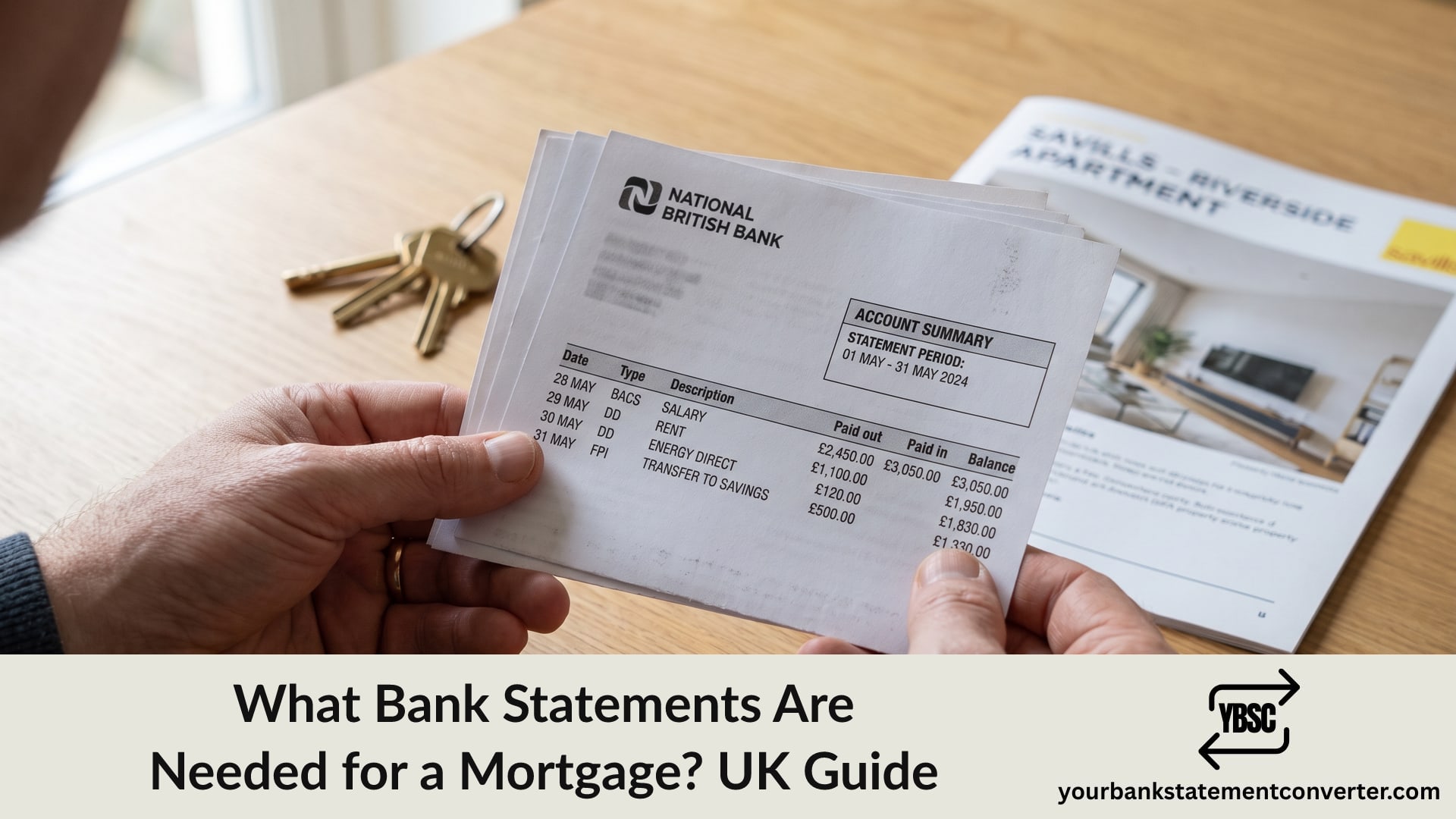
Official PDFs downloaded from your bank are the standard. They carry the bank’s formatting, your name and address, the account number and the statement period.
Paper statements are fine, scanned clearly and in full.
Screenshots are not accepted. Neither are transaction lists exported to spreadsheets, or anything from a budgeting app.
Edited files are fraud. Redacting, cropping or altering a statement submitted for a mortgage is a criminal matter, not a grey area. If something needs explaining, explain it in writing instead.
Every page counts too, including pages that look empty. A statement running “page 2 of 5” needs all five.
What Else You Will Need Alongside Them
Statements never travel alone. Prepare these at the same time.
- Payslips, usually the last three months
- A P60, for the most recent tax year
- Photo ID and proof of address
- A gifted deposit letter, if family are contributing
- SA302s or tax year overviews, for self-employed applicants, typically two to three years
- Company accounts, where you are a director
The self-employed documents matter most. Lenders average your income across years rather than taking your best one, so those figures need to reconcile with what your statements show.
Reading Them Before You Send Them
Whatever you hand over, an underwriter reads line by line. It is worth doing the same first.
Our guides to what lenders look for on bank statements and what mortgage underwriters look for cover exactly which entries attract questions, from gambling to undisclosed borrowing.
Reading six months across several accounts by hand is slow. Our bank statement converter turns PDF statements into clean, searchable spreadsheets, so you can total committed spending, trace how a deposit built up, and spot anything that needs a covering note before an underwriter asks.
Timing Your Application
One practical point that costs nothing and helps a lot.
Statements are a snapshot of recent behaviour, so the months before you apply are the ones that matter. Applying immediately after a new credit card, a large unexplained deposit or an overdrawn month invites questions.
Where you can wait, three clean months materially improves how an application reads.
Conclusion
To sum up, what bank statements are needed for a mortgage in the UK comes down to six months from every account you use, including the one holding your deposit, supplied as complete unedited PDFs from your bank. Add payslips, a P60 and, if self-employed, SA302s covering two or three years. Never edit a statement, never omit an account, and read them yourself before sending, because an underwriter certainly will.
FAQ
1.What bank statements are needed for a mortgage?
Most UK lenders want three to six months, with six the norm. Include every account you use, particularly the one holding your deposit, supplied as official PDFs from your bank.
2.How many months of bank statements do mortgage lenders need?
Three at minimum, six commonly, and longer where a deposit needs tracing. Self-employed and variable-income applicants should expect the longer end.
3.Do I need to provide statements for all my accounts?
Yes, for any account you actually use, plus the one holding your deposit. Omitting an account causes queries, because underwriters cross-reference transfers between accounts.
4.Can I send screenshots of my banking app?
No. Lenders require the bank’s official PDF or a clear scan of a paper statement, complete with every page. Screenshots and app exports are rejected.
5.Can I redact anything from my bank statements?
No. Editing a statement submitted for a mortgage is fraud. Where a transaction needs explaining, provide a written explanation alongside the unaltered statement.
6.What do self-employed applicants need as well?
SA302s or tax year overviews covering two to three years, plus company accounts if you are a director. Lenders average your income across those years rather than using the best one.