
Card payments at restaurants often reach your bank under a company name rather than the sign above the door. Alderforce on a bank statement follows that pattern. The meal you paid for is usually easy to place once you know what to look for.
This guide explains what the Companies House record shows and why the venue name goes missing. It also covers how to trace the charge to a visit, and when a query is justified.
Key Takeaways
- Alderforce Limited is a UK company, number 04971534, registered in Wembley.
- Companies House lists its activity as an unlicensed restaurant and cafe.
- Related companies, Alderforce North and Alderforce SC, share the same address.
- The venue name rarely appears, because the operating company takes the payment.
- Matching the date and amount to a meal out identifies the charge faster than calling anyone.
What the Companies House Record Shows
Alderforce Limited was incorporated in November 2003 and is registered at 34 to 36 London Road, Wembley. Its listed business activity covers unlicensed restaurants and cafes, meaning food service without a full alcohol licence.
Two related companies sit at the same registered address:
- Alderforce North Limited, incorporated in February 2010
- Alderforce SC Limited, a further entity in the same group
A cluster of companies at one address, each running food outlets, is the standard structure for an operator running several sites. Each location often sits in its own company for accounting and liability reasons.
Why the Restaurant Name Does Not Appear
This is the part that makes the entry confusing, and it applies far beyond this one company.
Your bank records the merchant account that took the payment, not the branding on the premises. When an operator runs outlets under a brand, the card terminal is frequently registered to the operating company instead.
That produces a familiar mismatch:
- You ate somewhere with a recognisable name above the door
- The card terminal belongs to the company that runs that site
- Your statement shows the company, which you have never heard of
Franchised food outlets work this way almost universally. The franchisor owns the brand, while the franchisee runs the site and holds the merchant account. Our guide to what the abbreviations on a bank statement mean covers that wider habit. Statements name a processor or operator, rarely the place you visited.
How to Trace the Charge to a Visit
Date and amount do most of the work here.
- Check the transaction date against days you ate out or bought food on the go
- Look at the amount, since a cafe bill and a restaurant meal sit at different scales
- Check the location, because the Wembley registration points to the London area
- Ask others with card access, as household and family cards complicate the picture
- Look for a receipt in a coat pocket, bag or email inbox
A card payment near a stadium, retail park or high street usually closes the question, provided you were in that area that day.
Why Several Entries May Look Identical
Group structures explain a detail that otherwise looks odd.
Where an operator runs several sites, visits to different locations can produce entries under one company name. Two charges a week apart from different parts of town are not necessarily an error.
The reverse also happens. One brand’s outlets may appear under different company names depending on who runs each site. That is why the same coffee chain can show up three ways on one statement.
When the Charge Deserves a Query
Most entries of this kind need nothing at all. A few genuinely warrant a call.
The amount is far larger than a meal. Restaurant charges have a natural ceiling. A figure well beyond a plausible bill is worth checking, including for a mistyped total or a duplicated transaction.
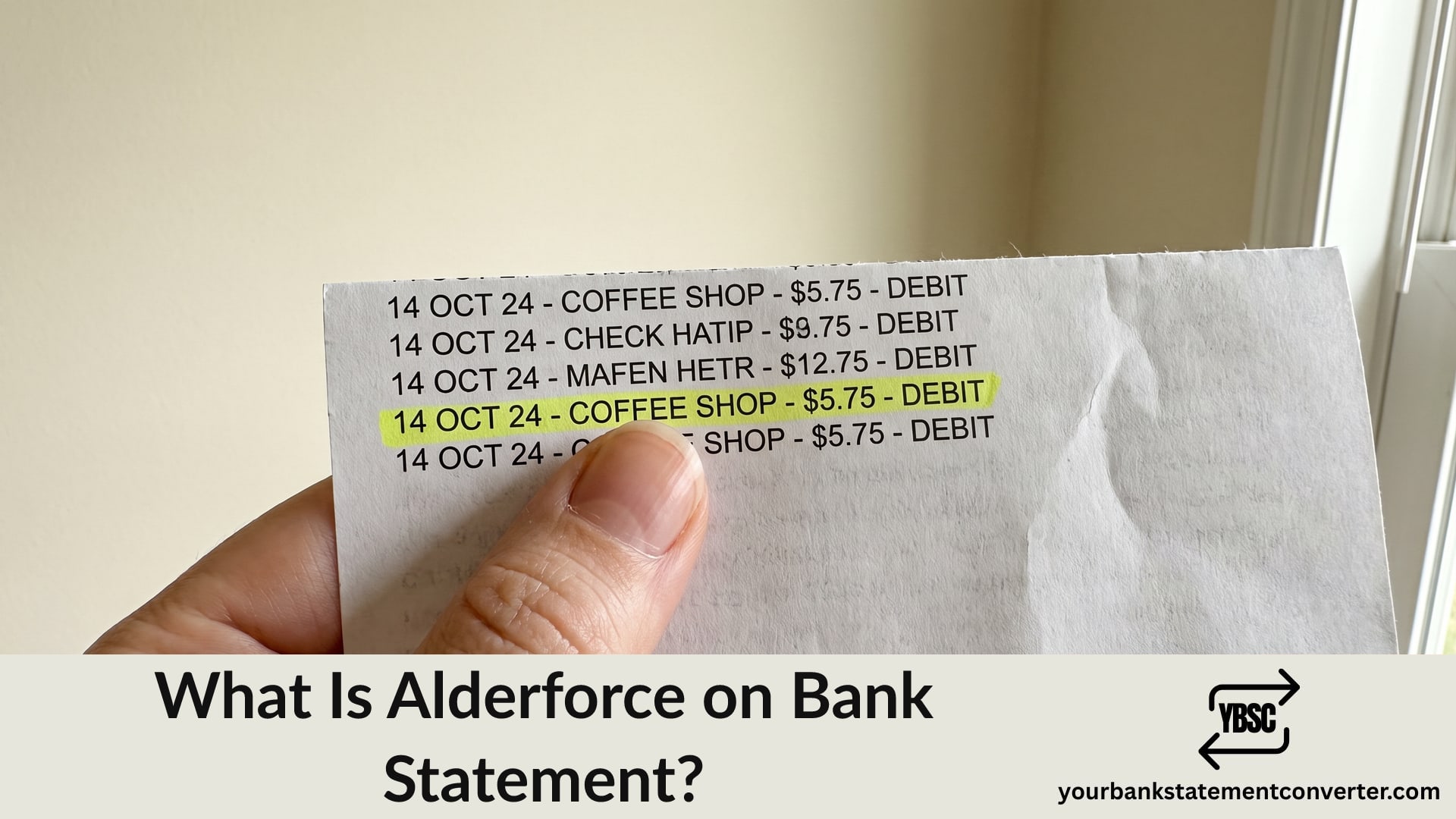
The same amount appears twice. Card terminals occasionally double-process. Where two identical Alderforce on bank statement charges land on the same day, one may be a duplicate.
You have not been to the area. If no visit fits for anyone with card access, treat it as a possible unauthorised transaction.
In each case, contact your bank first. They can request the merchant’s full details and often tell you the terminal location, which settles the question quickly.
Checking a Tip or a Duplicate
Restaurant payments carry two habits that surprise people.
A card terminal sometimes authorises one amount and settles another when a tip goes on afterwards. The final figure on your statement can therefore exceed the total you remember approving.
Pending amounts also drop off and reappear as the transaction settles. That can look like two charges when only one will ever complete. Comparing your available balance against the posted entries clarifies this, and what is on a bank statement explains how balances and pending items relate.
Finding Every Charge From the Same Operator
One entry is easy to check by hand. Several months of eating out is not.
Our bank statement converter turns PDF statements into clean, searchable spreadsheets. Filter the description column for the company name and sort by date. Every visit then lines up together, so you can see at a glance whether the pattern matches your own.
Conclusion
To sum up, Alderforce on a bank statement is a card payment to a UK food service operator registered in Wembley. Companies House lists its activity as unlicensed restaurants and cafes. The venue name does not appear because the operating company holds the merchant account, which is normal for restaurant and franchise payments. Match the date and amount to a meal out, and only query it when the figure, the repetition or the location does not fit.
FAQ
1.What is Alderforce on a bank statement?
It is a card payment to Alderforce Limited, a UK company registered under number 04971534 in Wembley. Companies House lists its activity as unlicensed restaurants and cafes.
2.Why does the restaurant name not show?
Your bank records the merchant account that processed the payment. Where an operator runs a site, the terminal is often registered to that company rather than to the brand on the door.
3.Are Alderforce North and Alderforce SC the same business?
They are separate registered companies sharing the same Wembley address. Running each site through its own company is a common structure for operators with several outlets.
4.Why do I have two identical charges?
Either two genuine visits, or a terminal that double-processed. Compare the times and locations, and ask your bank to check whether one is a duplicate.
5.The amount is higher than my bill. Why?
A tip added after the card was presented settles at a different figure from the one originally authorised. That gap is the usual explanation for a restaurant charge exceeding the total you remember.
6.I have never been to the area. What should I do?
Report it to your bank as a possible unauthorised transaction and ask for the merchant’s full details, including the terminal location. Request a replacement card if the payment was not authorised.






