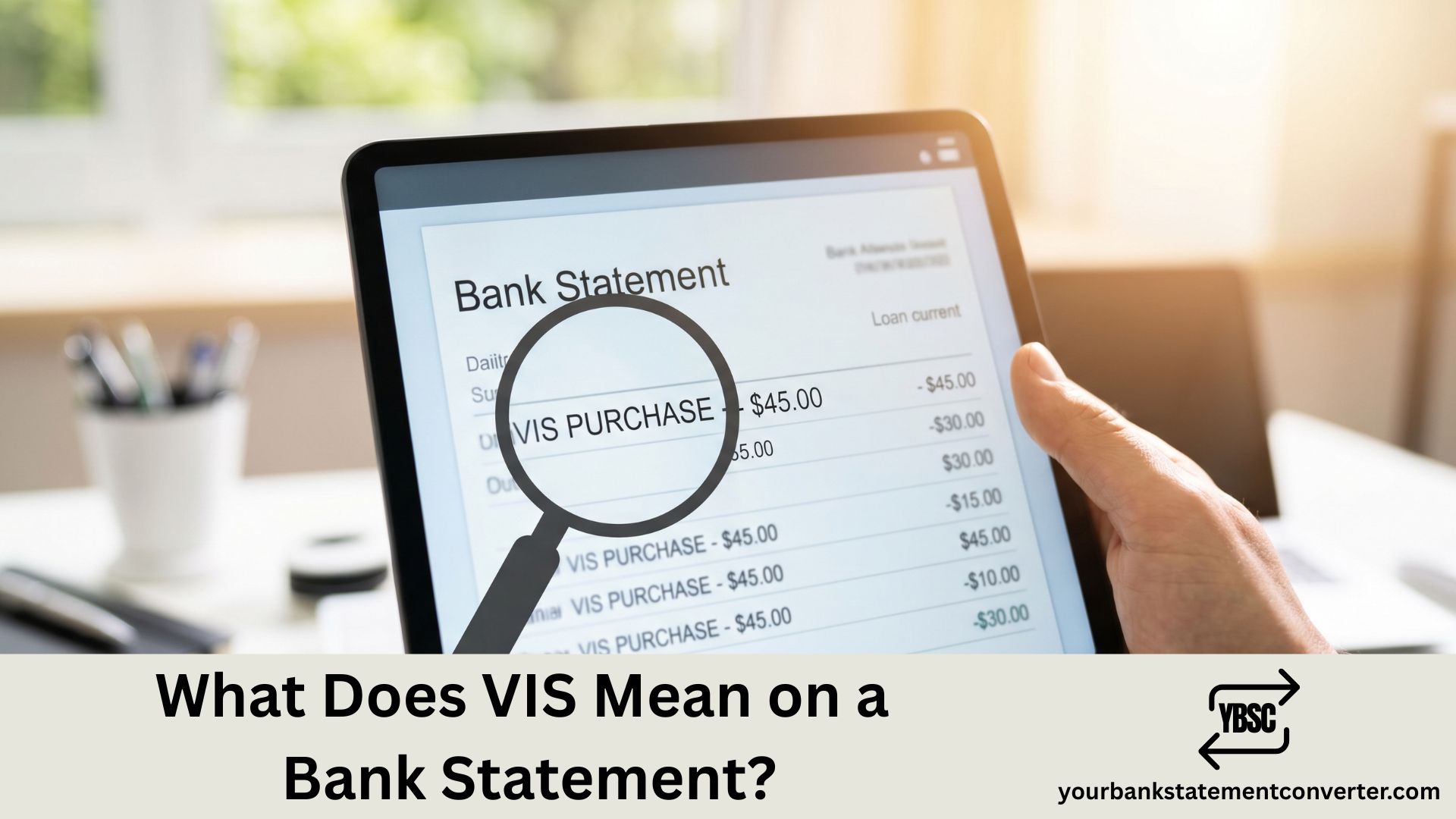
Spotted “VIS” on your bank statement and wondering what it means? You’re not alone—thousands of UK bank customers search for this abbreviation every month. Whether you’re reviewing your Barclays, HSBC, Lloyds, NatWest, or Nationwide statement, understanding these codes is essential for tracking your spending and spotting potential fraud. This guide explains exactly what VIS means, why it appears on your statement, and what to do if you don’t recognise the charge.
Key Takeaways
- VIS is short for VISA (credit or debit cards).
- Not necessarily. VIS simply indicates a Visa card transaction.
- VIS INT’L appears when a payment is forwarded between banks after you’ve switched accounts under UK banking rules using the Current Account Switch Service.
- Banks use abbreviated codes due to character limits on statement entries.
- Call your bank or credit card company immediately to notify them of the suspected fraudulent charge.
What Does VIS Mean on a Bank Statement?
The abbreviation “VIS” holds the key to understanding transactions associated with VISA debit or credit cards. When this acronym appears on your bank statement, it signals a specific charge linked to your VISA card usage.
In simple terms, VIS = VISA card transaction.
Every time you purchase with your VISA card, whether it’s a quick swipe at your local store or an online splurge, the bank processes the transaction and records it as a VIS Bank Charge on your statement.
Common VIS Formats on UK Bank Statements
| Abbreviation | Meaning |
|---|---|
| VIS | Visa transaction |
| VISA | Visa transaction |
| VIS DEBIT | Visa debit card payment |
| VIS CR | Visa credit card payment |
| VIS INT’L | International transaction (forwarded between banks) |
Why Does VIS Appear on My Statement?
The VIS Bank Charge is a specific transaction entry that appears on your bank statement, primarily associated with VISA debit or credit card usage. When you use your VISA card for purchases or other financial activities, the bank records this charge to document the transaction.
VIS entries typically appear when you:
- Make in-store purchases with your Visa card
- Shop online using your Visa debit or credit card
- Withdraw cash from ATMs
- Make contactless payments
- Set up subscriptions or recurring payments
This charge may also refer to an international transaction made using a Visa credit or debit card. When you use your Visa card to make a purchase outside of your home country, the transaction may be subject to additional fees or charges including foreign transaction fees and currency conversion fees.
How to Identify VIS Charges on Your Statement
The VIS charge is typically labeled as “VIS” or “VISA,” providing a clear indication of its association with VISA card transactions. Many transactions include the name of the merchant or establishment where the purchase occurred, aiding in identifying the source of the charge.
Key Details to Look For
- Transaction date – When the payment was made
- Merchant name – The shop or website you purchased from
- Amount – How much was charged
- Reference number – Unique transaction ID
Some banking apps or platforms may categorize the VIS Bank Charge under specific labels, such as “Debit Card Transaction” or “VISA Purchase.”
What Does VIS Mean on HSBC Statements?
VIS on an HSBC statement stands for “Visa International Service Assessment.” It’s a fee charged by Visa for processing international transactions.
If you see this on your HSBC statement following an overseas purchase, it’s typically a standard processing fee—not an error.
What is VIS INT’L on My Statement?
When you change banks under UK rules, the new bank and the old bank enter into an agreement that means the old bank can make payments and forward the cost to your new bank for up to three years.
If during that time someone needs to take a payment but they only have your old account details, the transaction will be honoured by your old bank and forwarded to your new bank. It will then appear on some bank’s statements as VIS INT’L followed by a number.
This is common if you’ve recently switched banks using the Current Account Switch Service.
Need Help Managing Your Bank Statements?
Keeping track of multiple transactions and statement codes can be overwhelming. Our online bank statement converter helps UK customers:
- ✅ Convert bank statements between formats (PDF to Excel, CSV, etc.)
- ✅ Organise transaction data for budgeting or tax purposes
- ✅ Create cleaner, easier-to-read financial records
👉 Visit our free online bank statement converter →
What to Do If You Don’t Recognise a VIS Charge
If you’re unfamiliar with the merchant and the transaction, it could be a fraud or unauthorised transaction. Take note of the unfamiliar transaction, including the merchant’s name, the amount, and the date.
Steps to Take
- Check your receipts – Match the date and amount to recent purchases
- Search the merchant name – Retailers sometimes trade under different names
- Ask household members – If you share the account, someone else may have made the purchase
- Check subscriptions – Could be an auto-renewing service you forgot about
- Contact your bank immediately – Notify them of the suspected fraudulent charge, ask for their dispute procedure, and request a fraud investigation
Secure Your Account
- Update your online banking passwords
- Set up alerts for new transactions
- Consider freezing your credit if necessary
How to Prevent Unauthorised VIS Transactions
Preventing unauthorized VIS debits is crucial to safeguard your finances and protect yourself from potential fraudulent activities.
Top Tips
| Tip | Action |
|---|---|
| Monitor regularly | Review your bank statements and transaction history through online banking or mobile apps at least once a week |
| Enable alerts | Set up real-time notifications on your mobile phone or email for every purchase made with your VISA debit card |
| Protect your details | Never share your card details on unsecured websites |
| Use strong passwords | Create unique passwords for online banking |
| Report immediately | Report lost or stolen cards to your bank straight away |
Organise Your Finances with Ease
Whether you’re tracking VIS charges, preparing for a mortgage application, or simply want cleaner financial records, our bank statement to Excel converter makes managing your UK bank statements simple. If this is work you repeat, the pricing page sets out the per-page tiers.
FAQs: VIS on Bank Statement UK
Unfamiliar entries are rarely a sign of anything wrong. Our guide to what the abbreviations on a bank statement mean decodes the type codes, and what is on a bank statement explains how each section of the page fits together.
1) What does VIS mean on my bank statement?
VIS is short for VISA (credit or debit cards). It indicates a transaction processed through your Visa card.
2) Is VIS on my bank statement a scam?
Not necessarily. VIS simply indicates a Visa card transaction. However, if you don’t recognise the merchant or amount, it could be fraudulent. Contact your bank immediately to investigate.
3) What does VIS INT’L mean on my statement?
VIS INT’L appears when a payment is forwarded between banks after you’ve switched accounts under UK banking rules using the Current Account Switch Service.
4) Why do banks use abbreviations like VIS?
Banks use abbreviated codes due to character limits on statement entries. VIS is a standard shorthand for VISA transactions across most UK banks.
5) How do I dispute an unknown VIS charge?
Call your bank or credit card company immediately to notify them of the suspected fraudulent charge. Ask them for a specific procedure for disputing the charge and request a fraud investigation.
6) Does VIS appear differently on different UK banks?
Yes. While the core meaning is the same, formatting varies. You might see VIS, VISA, VIS DEBIT, or VIS CR depending on your bank (Barclays, HSBC, Lloyds, NatWest, Santander, etc.).
7) Can I hide VIS transactions on my bank statement?
No, you cannot hide transactions from your bank statement. All transactions are recorded for financial transparency and regulatory compliance.