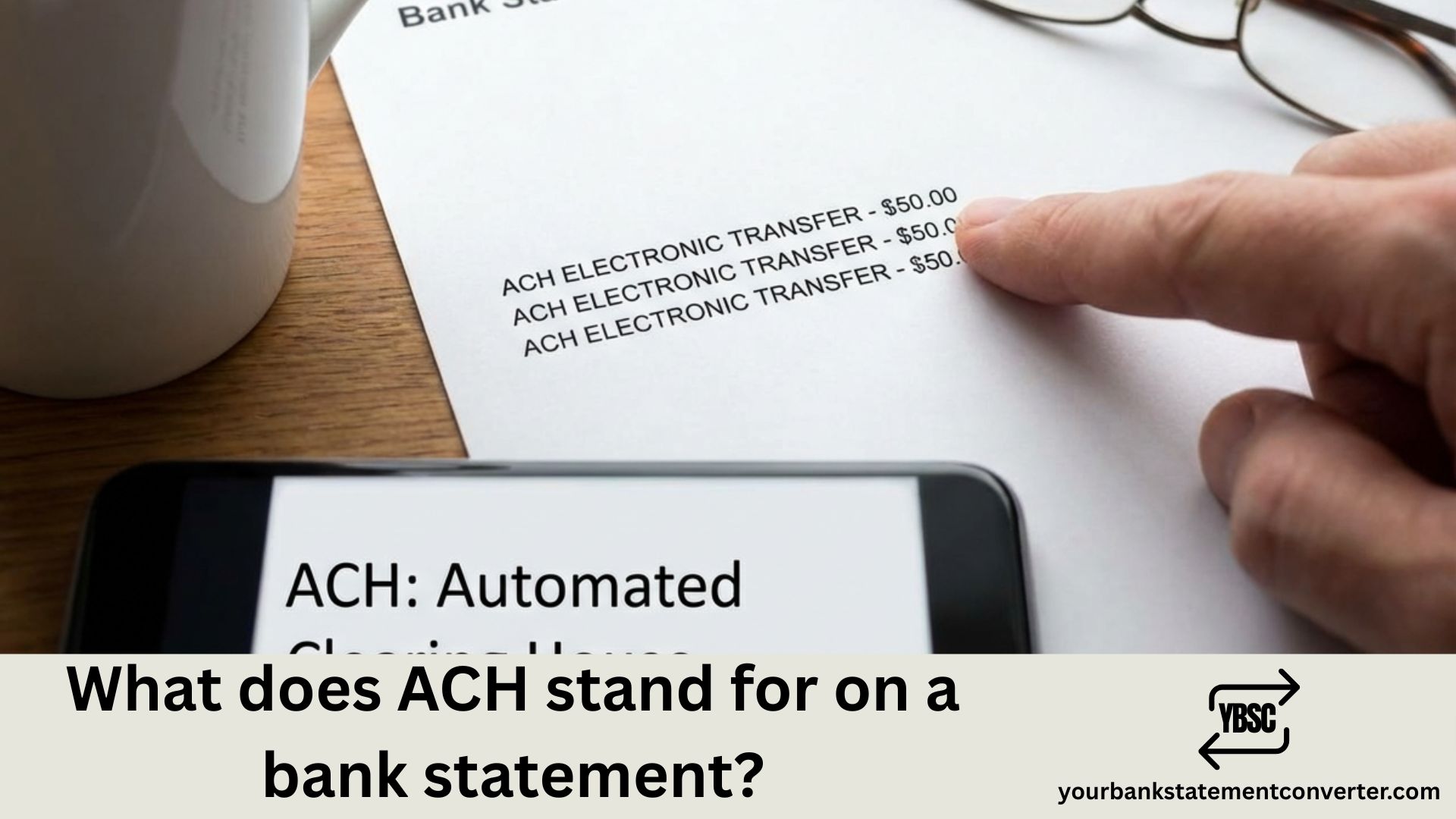
If you’ve spotted “ACH” on your bank statement and wondered what it means, you’re looking at one of the most common transaction types in American banking. Whether it’s labeled ACH CREDIT, ACH DEBIT, or ACH TRANSFER, understanding this term helps you track your money and identify legitimate transactions versus potential errors.
What Does ACH Stand for on a Bank Statement?
ACH stands for Automated Clearing House—a nationwide electronic network that processes financial transactions between banks and credit unions across the United States. When you see ACH on your bank statement, it indicates an electronic money transfer that moved funds into or out of your account without using cash, paper checks, wire transfers, or credit card networks.
The ACH network, managed by Nacha (National Automated Clearing House Association), processed over 33 billion payments worth more than $86 trillion in 2024 alone. Chances are, you use ACH transfers regularly without even realizing it—your paycheck direct deposit, automatic bill payments, and online bank transfers all flow through this system.
How ACH Transactions Appear on Your Bank Statement
ACH entries on your statement typically include descriptive text identifying the transaction type and source. Common formats include:
| Statement Entry | What It Means |
|---|---|
| ACH CREDIT | Money deposited into your account (incoming funds) |
| ACH DEBIT | Money withdrawn from your account (outgoing payment) |
| ACH DIRECT DEP | Direct deposit (paycheck, government benefits) |
| ACH PAYMENT | Bill payment or scheduled transfer |
| ACH WITHDRAWAL | Authorized automatic withdrawal |
| ACH TRANSFER | Movement of funds between accounts |
| ACH [COMPANY NAME] | Payment to/from a specific business |
ACH Credit vs. ACH Debit: Understanding the Difference
The two main types of ACH transactions work in opposite directions:
ACH Credit (Push Transactions) Money is “pushed” into your account from an external source. The sender initiates the transfer. Examples include:
- Paycheck direct deposits from your employer
- Tax refunds from the IRS
- Government benefits (Social Security, unemployment)
- Refunds from businesses
- Person-to-person payments (Venmo, Zelle withdrawals to bank)
ACH Debit (Pull Transactions) Money is “pulled” from your account by an authorized party. The recipient initiates the transfer with your permission. Examples include:
- Monthly utility bill payments
- Mortgage or rent payments
- Subscription services (Netflix, gym memberships)
- Insurance premiums
- Loan repayments
Common Examples of ACH Transactions
Here’s what different ACH entries on your statement likely represent:
Incoming ACH Credits:
- Employer payroll deposits
- Social Security or pension payments
- Tax refunds
- Vendor payments (if you’re a freelancer)
- Investment dividends
- Rebates and cashback rewards
Outgoing ACH Debits:
- Electric, gas, and water bill autopay
- Cell phone and internet bills
- Credit card automatic payments
- Student loan payments
- Health insurance premiums
- Streaming service subscriptions
How ACH Transfers Work Behind the Scenes
The ACH process involves several steps, though it happens automatically once set up:
- Initiation: You (or an authorized party) requests a transfer through a bank or payment service
- Batching: Your bank collects ACH requests and sends them in batches to an ACH operator
- Processing: The ACH operator (either the Federal Reserve or The Clearing House) sorts transactions and routes them to receiving banks
- Settlement: The receiving bank credits or debits the appropriate account
- Completion: Funds become available, typically within 1-3 business days
Unlike wire transfers that process individually in real-time, ACH transactions are batched and processed at set intervals throughout the day, which keeps costs low but means transfers aren’t instant.
ACH Processing Times
Standard ACH transfers take 1-3 business days to complete, though timing varies:
- Same-Day ACH: Available for transfers up to $1 million (may incur additional fees)
- Next-Day ACH: Most common for standard transfers initiated during business hours
- 2-3 Business Days: Typical for transactions initiated after cutoff times or involving additional verification
ACH does not process on weekends or federal holidays, so keep this in mind when scheduling time-sensitive payments.
Simplify Your Bank Statement Review Process
Tracking multiple ACH transactions across different accounts can become overwhelming—especially when you’re trying to identify unfamiliar charges, reconcile business expenses, or prepare for tax season.
Your Bank Statement Converter transforms this tedious process by instantly converting your bank statements into organized Excel, CSV, or PDF formats. Whether you’re a bookkeeper managing client accounts, a small business owner tracking cash flow, or an individual organizing personal finances, this tool helps you:
- Quickly filter and sort ACH transactions by type, date, or amount
- Identify recurring payments and subscription charges at a glance
- Convert PDF bank statements into searchable, editable spreadsheets
- Streamline reconciliation for accounting and tax preparation
👉 Try Your Bank Statement Converter today and take control of your financial records.
Benefits of ACH Payments
ACH has become the backbone of electronic payments in the US for good reasons:
Low Cost: ACH transfers are typically free for consumers and cost businesses just pennies per transaction—far cheaper than credit card processing fees (2-3%) or wire transfers ($15-50).
Security: Electronic transfers create automatic paper trails and eliminate risks associated with lost checks or stolen cash.
Convenience: Set up autopay once and never worry about missed payments or late fees again.
Reliability: The ACH network has operated since 1972 with consistent, regulated processes overseen by the Federal Reserve.
Automation: Recurring payments happen automatically on schedule without manual intervention.
Potential Drawbacks to Consider
Processing Delays: Unlike wire transfers or card payments, ACH isn’t instant. Plan ahead for time-sensitive payments.
Overdraft Risk: Automatic debits can trigger overdraft fees if your account balance is insufficient.
Reversal Limitations: While ACH transactions can be disputed, reversals are more restrictive than credit card chargebacks.
Daily/Monthly Limits: Many banks cap ACH transfer amounts, typically ranging from $3,500 to $25,000 per day for personal accounts.
What To Do If You Don’t Recognize an ACH Transaction
Unfamiliar ACH entries require investigation:
- Check the descriptor: Look for company names, abbreviations, or reference numbers in the transaction details
- Review recurring payments: Cross-reference with subscriptions, memberships, or autopay arrangements you’ve authorized
- Search your email: Look for payment confirmations or receipts matching the transaction date and amount
- Contact your bank: Request additional transaction details—they can often provide more information about the originating company
- Dispute if unauthorized: If the transaction is truly fraudulent, report it to your bank within 60 days to initiate a dispute
ACH on Bank Statements: Key Takeaways
ACH stands for Automated Clearing House—the electronic network powering most everyday financial transactions in the United States. When you see ACH CREDIT on your statement, money came in; when you see ACH DEBIT, money went out. From paychecks and tax refunds to utility bills and subscription payments, ACH handles the behind-the-scenes movement of funds that keeps modern financial life running smoothly.
Understanding ACH transactions helps you monitor your accounts effectively, catch unauthorized charges early, and manage your cash flow with confidence. For those dealing with multiple accounts or complex financial records, tools like Your Bank Statement Converter can transform raw bank data into actionable insights—saving time and reducing errors in your financial management. Anyone doing this across several months at a time will want to look at the monthly plans, which are priced by page count.
Frequently Asked Questions (FAQs)
What does ACH stand for in banking?
ACH stands for Automated Clearing House, a US electronic network that facilitates bank-to-bank transfers. It handles direct deposits, bill payments, and electronic transfers between more than 10,000 financial institutions nationwide.
Is an ACH payment the same as a direct deposit?
Direct deposit is a type of ACH payment. Specifically, it’s an ACH credit transaction where funds are pushed into your account—most commonly used for payroll, tax refunds, and government benefits. All direct deposits are ACH transactions, but not all ACH transactions are direct deposits.
How long do ACH transfers take?
Standard ACH transfers take 1-3 business days. Same-day ACH is available for transactions up to $1 million but may involve additional fees. ACH does not process on weekends or federal holidays.
Why is there an ACH debit I don’t recognize on my statement?
Unrecognized ACH debits could be legitimate autopay arrangements you forgot about, company name variations (businesses sometimes use different billing names), or potentially unauthorized transactions. Check your email for confirmations, review your subscriptions, and contact your bank if you can’t identify the source.
Can ACH payments be reversed or cancelled?
ACH payments can be reversed under specific conditions, such as incorrect amounts, duplicate transactions, or unauthorized debits. However, reversals must follow strict Nacha rules and time limits. Contact your bank immediately if you need to dispute an ACH transaction—consumers typically have 60 days to report unauthorized debits.
What’s the difference between ACH and wire transfers?
ACH transfers are batch-processed, take 1-3 days, and are inexpensive or free. Wire transfers are processed individually in real-time (same day) but cost $15-50. ACH is better for routine payments; wire transfers suit urgent, high-value transactions.
Are ACH payments safe?
Yes, ACH payments are highly secure. The network is regulated by the Federal Reserve and Nacha, with strict rules governing transactions. Electronic transfers also eliminate risks associated with lost or stolen checks. However, you should still monitor your accounts and report unauthorized transactions promptly.
What does “ACH CREDIT” mean on my bank statement?
ACH CREDIT means money was deposited into your account through the ACH network. Common sources include paycheck direct deposits, tax refunds, government benefits, vendor payments, and refunds from businesses.
What does “ACH DEBIT” mean on my bank statement?
ACH DEBIT means money was withdrawn from your account through the ACH network. This typically indicates an automatic bill payment, subscription charge, loan payment, or other authorized recurring withdrawal.
How can I easily track and organize ACH transactions on my bank statements?
Using a tool like Your Bank Statement Converter allows you to convert PDF bank statements into organized spreadsheets where you can filter, sort, and analyze ACH transactions by date, amount, or type—making reconciliation and expense tracking significantly easier.
Is Zelle the same as ACH?
Zelle uses the ACH network infrastructure but processes payments differently—typically delivering funds within minutes rather than days. Essentially, all Zelle payments utilize ACH rails, but standard ACH payments don’t have Zelle’s instant transfer capability.
What is the ACH transfer limit?
ACH transfer limits vary by bank and account type. Personal accounts typically range from $3,500 to $25,000 per day. Same-Day ACH has a per-transaction limit of $1 million. Check with your specific financial institution for its policies.